
Does a cracked or loose roofline mean you need everything replaced? Not necessarily. For fascia and soffit repairs Norfolk homeowners need, the first step is finding out whether damage is limited to a board or has affected the timber behind it. Staining, peeling paint and overflowing gutters can all point to a problem, but they don’t automatically mean a full replacement is needed.
It’s understandable to worry that a small defect could let water in and lead to damp or further deterioration. This guide explains what to look for, how repairs are assessed and when replacing more of the roofline may make sense. I R. Wilson Roofing carries out fascia and soffit repairs, and our free consultation is an opportunity to talk through what you’ve noticed and the practical next steps.
Key Takeaways
- Fascia boards run along the roof edge, while soffits cover the underside of the eaves. Loose boards, cracks, peeling finishes or staining can signal roofline damage.
- For fascia and soffit repairs Norfolk homeowners can note what they’ve spotted, where it is and when it appeared. This helps focus the assessment on the right areas.
- A careful assessment considers visible damage alongside related timber and guttering concerns, so the repair plan reflects the cause and scope of the problem.
- I R. Wilson Roofing is a family-run team serving Norwich and surrounding parts of Norfolk and Suffolk, including Yarmouth, Beccles, Wymondham, Mulbarton and Wroxham.
Fascia and soffit repairs in Norfolk: signs your roofline needs attention
Fascia boards run along the edge of the roof, where the roof covering meets the outside wall. Soffits sit underneath the eaves, closing the gap between the wall and roof edge. Both form part of the roofline, but damage can appear in different places. The Fascia (architecture) overview offers a useful introduction to the term.
From the ground, look for changes such as:
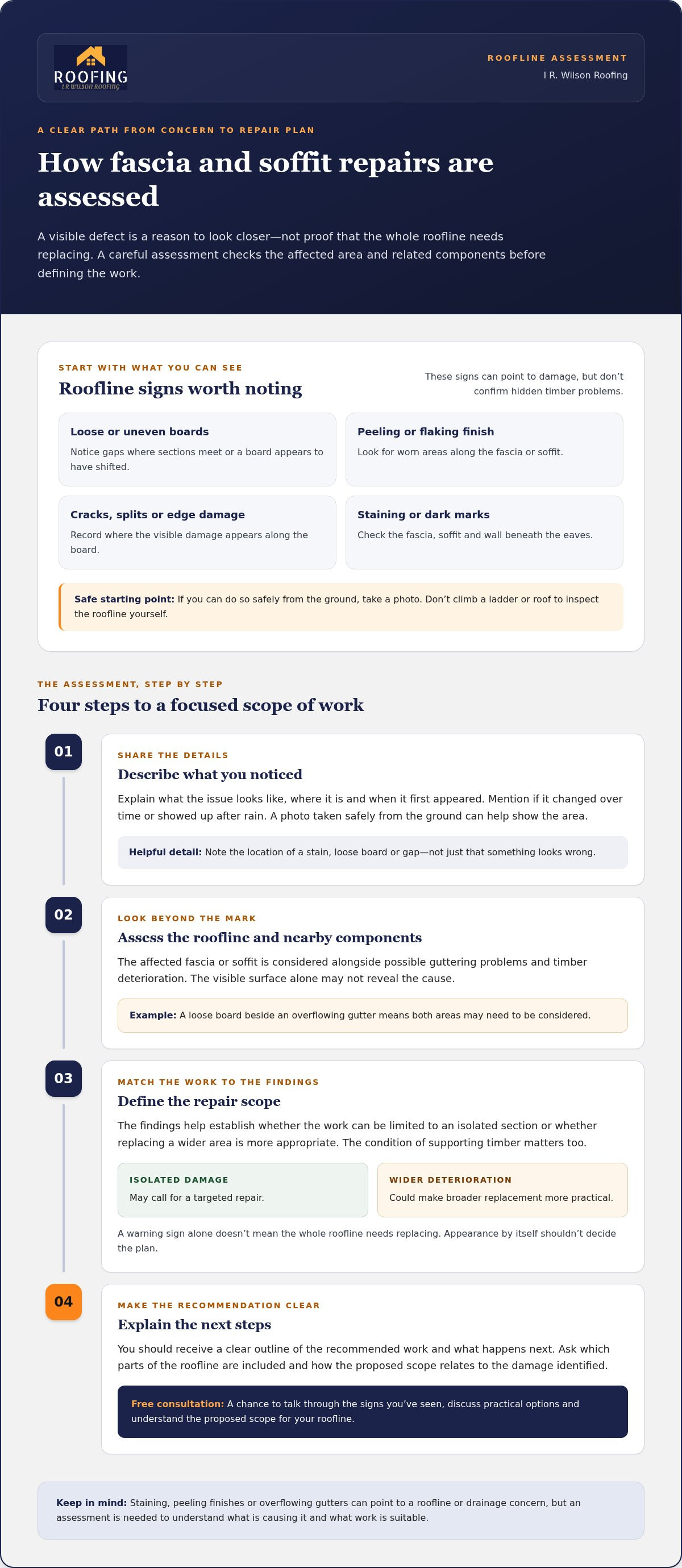
- Loose or uneven boards, or gaps where sections meet.
- Peeling or flaking finishes that leave the surface looking worn.
- Cracks, splits or visible damage along the board edges.
- Staining or dark marks on the fascia, soffit or wall below the eaves.
These signs are a good reason to arrange an assessment, but they don’t prove that hidden timber is damaged. Don’t climb a ladder or roof to inspect the roofline yourself. If you can do so safely from the ground, take a photo and note the location. Include whether the mark or movement seems to have changed over time, or appeared after rain. These details give your roofer a useful starting point.
What damage can look like on Norfolk homes
Roof edges are exposed to rain, wind and everyday wear. Damp around the eaves may show as discolouration, while finishes can peel or boards can appear loose. For example, a stain beneath the eaves near a gutter could point to a roofline or drainage concern. But appearance alone can’t tell you whether the cause is surface wear, a guttering issue or damage to timber or another component.
With fascia and soffit repairs Norfolk homeowners benefit from an assessment that looks beyond the visible mark. Checking the affected area and nearby roofline can help identify what needs attention before a repair is planned. Don’t assume that one warning sign means the whole roofline needs replacing, but don’t ignore a change that’s worsening or recurring either.
How fascia and soffit repairs are assessed and planned in Norfolk
A sound repair plan starts with understanding the problem, not assuming that every damaged board needs replacing. For fascia and soffit repairs Norfolk homeowners can expect the assessment to consider what’s visible and whether nearby roofline timber or guttering may also need attention. For instance, a loose board beside an overflowing gutter may call for both areas to be considered. Looking at the surrounding components helps distinguish a possible cause from its symptoms and keeps the proposed work focused.
- Describe the issue. Explain what you’ve noticed, where it is and when it first appeared. Photos taken safely from the ground can help show the area.
- Assess the roofline. The affected fascia or soffit is considered alongside related concerns, such as guttering problems or timber deterioration.
- Define the repair scope. The findings help establish whether work can be limited to an isolated section or whether wider replacement is more appropriate.
- Explain the next steps. You should receive a clear outline of the recommended work and what happens next.
Can damaged fascias or soffits be repaired instead of replaced?
Often, the right answer depends on the extent and cause of the damage. A single loose or damaged section may call for a targeted repair, while deterioration across a longer stretch could make broader replacement more practical. The condition of supporting timber matters too, so the visible surface alone shouldn’t determine the plan. Ask what parts of the roofline the work covers and how the proposed scope relates to the damage identified.
Building-science research can help explain how different parts of a building interact. Home Innovation Research Labs provides broader construction and building-science context, while the recommendation for your home should be based on its roofline condition. During a free consultation, we can discuss practical options and explain the proposed scope.
If you’d like to talk through what you’ve noticed, arrange a free consultation with our team.
Arrange fascia and soffit repairs with a local Norfolk roofing team
Once you’ve noticed a roofline concern, a conversation can help turn uncertainty into a practical next step. I R. Wilson Roofing is a family-run business serving Norwich and surrounding areas of Norfolk and Suffolk, including Yarmouth, Beccles, Wymondham, Mulbarton and Wroxham. When you get in touch, share your location, what you’ve spotted and when you first noticed it. For example, mention if a mark appeared after heavy rain or a board seems to have shifted over time.
What to expect when you request a roofline consultation
The free consultation is a chance to talk through your concern and the property’s roofline. We can discuss the signs you’ve seen, consider whether the fascia, soffit, timber or nearby guttering may need attention, and explain suitable options for the project. Advice and a quotation can be tailored to the work involved, so you can understand the proposed scope before deciding how to proceed.
If a gutter is overflowing or leaking, mention it too, as this may help explain what’s happening around the roof edge. Our guide to guttering services in Norwich covers related homeowner concerns.
You don’t need to know exactly what’s wrong before you speak with us. A clear description of what you’ve noticed is a useful starting point. For fascia and soffit repairs Norfolk homeowners can arrange a free consultation with I R. Wilson Roofing to discuss their roofline and suitable repair options. Get in touch with our team to arrange a conversation and take the next step at your own pace.
Take a clear next step for your roofline
Uncertainty can make a roofline concern feel bigger than it is. You don’t need to decide on a repair or replacement before speaking with a roofing team. An assessment gives you a clearer basis for choosing what suits your home, rather than relying on appearances alone. It can help you understand the work involved and plan with confidence.
If you’re considering fascia and soffit repairs Norfolk, use a free consultation to talk through your concerns, ask practical questions and understand the options. I R. Wilson Roofing serves homeowners in Norwich, Yarmouth, Beccles, Wymondham, Mulbarton, Wroxham and surrounding areas of Norfolk and Suffolk. A clear conversation is a sensible starting point, whether the issue is localised or needs broader attention.
You can take it one step at a time, with a clearer view of what your home needs.
Frequently Asked Questions
Can damaged fascias and soffits be repaired without replacing the whole roofline?
Yes, a full roofline replacement isn’t always necessary. If the issue is confined to one area, a repair may be suitable, while more widespread deterioration may call for a broader solution. For fascia and soffit repairs Norfolk homeowners should base the decision on the condition of the affected sections and what’s supporting them, rather than appearance alone.
Can damaged fascias cause damp inside a house?
They can contribute to water getting into parts of the roof edge or wall, but damp indoors can have other causes too. If you notice a new mark near an upstairs ceiling or external wall, note its position and whether it changes after rain. This information can help an inspection distinguish a roofline concern from another source of moisture.
How can I tell whether my soffits need attention?
Look for a panel that appears to bow, sag or pull away from the underside of the eaves. Unusual bird or insect activity around the roof edge may also be a reason to have the area checked. Use a ground-level view and avoid climbing to inspect it. A closer assessment can establish whether the soffit itself needs work.
Are fascia and soffit repairs different from gutter repairs?
Yes. Gutter repairs deal with the channels and fittings that collect and carry rainwater, while fascia and soffit work concerns the boards at and beneath the roof edge. The parts meet, so a gutter problem can affect nearby boards, or the other way round. This distinction can help homeowners in Norwich, Yarmouth, Beccles, Wymondham, Mulbarton and Wroxham describe the issue clearly.