
What if the damp patch inside your stable is only a small clue to a bigger roofing problem? A leak can damage the interior and put stored feed or equipment at risk, while the visible drip may not show where water is getting in. That’s why effective stable roof repairs start with finding the cause, not simply covering the stain.
If you’re unsure what work your Norfolk property needs, the right repair depends on the roof’s condition, covering and the extent of the damage. This guide explains what to look for, how to prepare for an assessment and what can shape the repair plan. I R. Wilson Roofing provides roof repairs across Norwich, Yarmouth, Beccles, Wymondham, Mulbarton and Wroxham, as well as the wider Norfolk and Suffolk area. A free consultation is a straightforward way to discuss your stable roof and understand the options.
Key Takeaways
- Look for water marks, damp patches, displaced roof coverings or visible sagging from a safe place on the ground.
- Stable roof repairs depend on the covering, extent of deterioration, timber condition, water entry and access.
- Record what you’ve noticed and describe the stable to make a roofing assessment more focused.
- A project-specific recommendation can clarify the next steps for your stable in Norwich, nearby towns or elsewhere in Norfolk and Suffolk.
Stable Roof Repairs: Spotting Damage Before It Spreads
A small leak can do more than leave a mark. Water entering through a stable roof may damage the interior and put belongings such as feed or equipment at risk. Spotting changes early gives you useful information to share when arranging stable roof repairs, even before the full extent of the problem is clear.
From a safe position on the ground, look for visible clues such as:
- Water marks or damp patches on the ceiling or walls
- Roof coverings that appear displaced or out of line
- Visible sagging in the roofline
- New dampness or marks near stored items
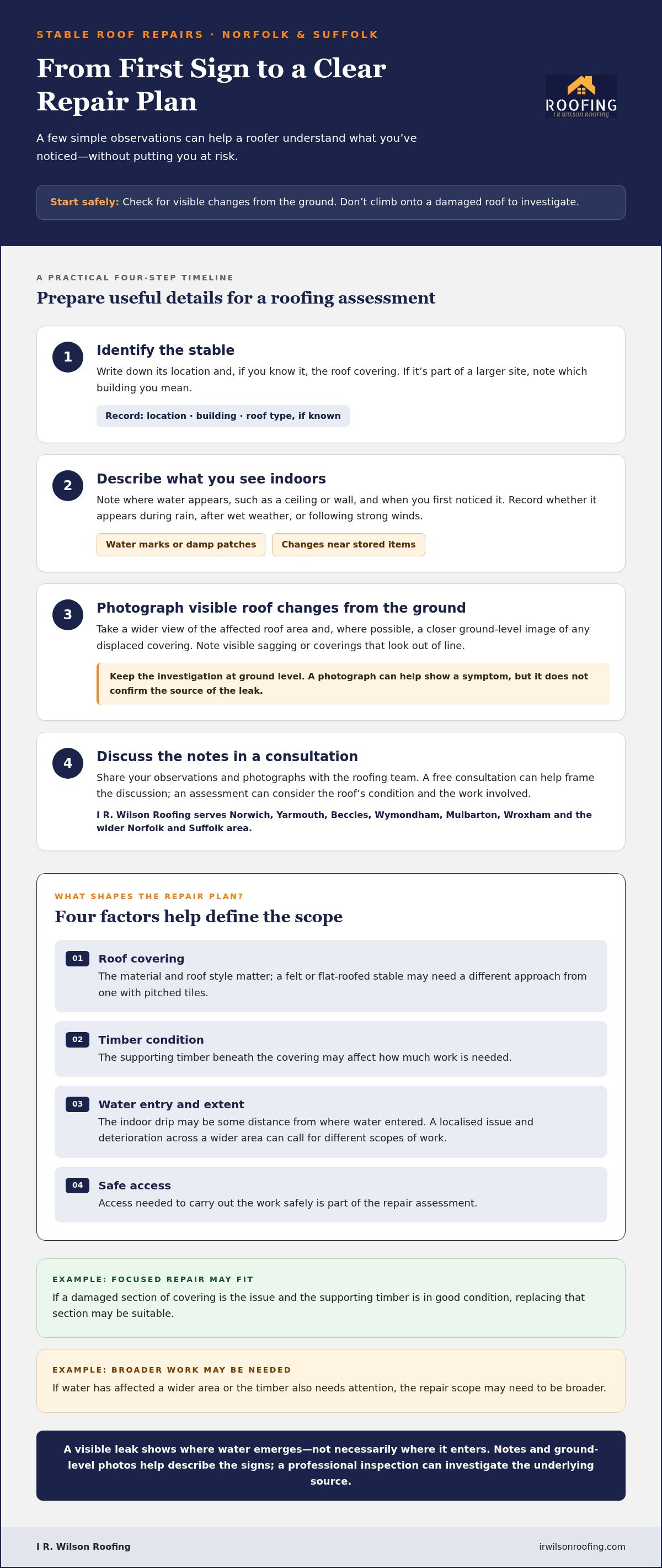
Don’t climb onto a damaged roof to investigate. Instead, note where you see each mark or change and take photographs from the ground. A wider view can show the affected roof area, while a closer ground-level image may capture a displaced covering. Keep a simple record of when you notice leaks and whether they change after wet or windy weather.
What can a stable roof leak tell you?
The spot where water appears indoors may be some distance from where it entered. Water can travel along roof materials or supporting parts before dripping onto a ceiling or wall. Timing can offer useful clues too, so note whether a leak appears during rain, after a period of wet weather or following strong winds.
A visible leak shows where water emerges, not necessarily where it enters. Roof construction involves layers and connected components, as outlined in Domestic roof construction. Your notes and photographs can help a roofer assess the symptoms, while a professional inspection can look for the underlying source.
Choosing the Right Stable Roof Repair in Norfolk and Suffolk
A small, localised area of damage may call for a focused repair, while deterioration across a wider part of the roof can point to more extensive work. There is no one-size-fits-all answer. The aim is to identify what has failed and whether the surrounding roof remains sound, rather than assume a patch will solve every leak.
The covering is only part of the picture. A roofer will consider its material, the condition of the timber beneath it, where water is entering and what access is needed to carry out the work safely. For example, replacing a damaged section of covering may be suitable if the supporting timber is in good condition. If water has affected a wider area or the timber also needs attention, the repair scope may need to be broader.
When might a repair be enough, and when is more work needed?
An assessment considers the visible covering and what can be established about the structure beneath it. A sound-looking patch nearby doesn’t automatically mean the rest of the roof is unaffected, just as one damaged area doesn’t automatically mean the whole roof needs replacing. For older or historic buildings, the Secretary of the Interior's Standards for the Treatment of Historic Properties offer a preservation reference, though they are US guidance rather than UK requirements.
Repair scope depends on the covering, underlying timber, water entry and access. A felt or flat-roofed stable may need a different approach from one with pitched tiles. See our flat roof repairs for more on that type of roofing work. I R. Wilson Roofing carries out stable roof repairs in Norfolk and Suffolk. A project-specific assessment can clarify suitable options and provide a recommendation and quotation based on the property and work required.
Planning Stable Roof Repairs with a Local Roofing Team
A clear repair discussion starts with useful details about the building and the problem. This helps the roofing team understand what you’ve noticed and assess your stable without relying on assumptions. I R. Wilson Roofing provides roof repairs in Norwich and nearby areas, including Yarmouth, Beccles, Wymondham, Mulbarton and Wroxham, across Norfolk and Suffolk.
What should you prepare before discussing the repair?
Keep your notes simple. Include the stable’s location, the roof type if you know it, where water appears inside and when you first noticed the issue. Ground-level photographs can show the building and visible changes without putting you at risk. If the stable is part of a larger site, note which building you mean.
- Write down the stable’s location and any details you know about its roof covering.
- Describe where the leak or damage appears and when it began.
- Gather clear photographs taken safely from the ground.
- Arrange a consultation and discuss the information with the roofing team.
During an assessment, the team can consider the roof’s condition and the work involved, then provide a project-specific recommendation and quotation. Guidance on Norwich roof repairs can also offer useful context on arranging repair work for a local property. For broader roofing information, the National Roofing Contractors Association (NRCA) provides industry resources; these are general references, not a substitute for advice tailored to a UK stable.
Bring your notes and photographs to a free consultation with I R. Wilson Roofing to discuss your stable and the signs you’ve recorded.
Take the Next Step Towards a Sound Stable Roof
A clear plan starts with understanding what your stable needs, so you can make decisions with confidence rather than guess at the cause or scope. If you’ve noticed changes to the roof, arranging an assessment is a practical next move. A professional recommendation can help you decide how to proceed with stable roof repairs based on the property and work required.
I R. Wilson Roofing is a family-run business operated by Ian Wilson and his son Ben, providing roof repairs in Norwich and surrounding areas across Norfolk and Suffolk, including Yarmouth, Beccles, Wymondham, Mulbarton and Wroxham. Bring your notes or photographs to a free consultation and talk through your stable roof with the team.
Taking that first step can make the way forward clearer. Your stable deserves a considered repair plan.
Frequently Asked Questions
Can a stable roof leak far from where the water appears inside?
Yes. Water can emerge indoors some distance from the roof opening, or become visible after rainfall has eased. If you notice more than one damp area, record each separately rather than assuming they share a single entry point. This gives the roofer a fuller picture during an assessment and avoids relying on one indoor mark alone.
Should I cover a leaking stable roof myself?
It’s best not to climb onto a leaking or damaged roof or try to cover it yourself. Working at height on an unstable surface can put you at risk, and an improvised cover may not stay secure. If it’s safe, move belongings away from drips and use a container to catch water indoors while arranging professional advice.
Can a damaged stable roof be repaired in sections?
Sometimes, yes. A repair may be limited to a defined section if an assessment finds the damage is localised and the surrounding roof is suitable to retain. The recommendation may differ if the roof’s condition varies or the work needs to address connected areas. Ask for the proposed scope to describe which parts are included.
What information helps when requesting a stable roof repair consultation?
Alongside describing the leak, mention any previous roof repairs or temporary patches and whether they changed the problem. If you know roughly when that work was done, include it, but don’t worry if you don’t. This background can help the roofer understand what has already been tried and assess the next step without you needing to diagnose the cause.