The "budget" choice for your flat roof might be the most expensive mistake you make this year. It's completely natural to feel frustrated when you're caught between conflicting advice from different contractors. You want a roof that keeps the Norfolk rain out without breaking the bank, but the fear of seams leaking on a traditional felt roof is a very real concern for many of our neighbors. We're here to help you navigate the true felt roof replacement cost Norwich homeowners are seeing in 2026, comparing it directly against modern GRP fibreglass.
You'll gain a clear understanding of the real-world differences in longevity, how the 2026 Building Regulations impact your insulation requirements, and why looking at the cost per year provides more peace of mind than just looking at the initial quote. Our team has spent years working on local homes, and we want to ensure you have the confidence to choose the right material for your property's future. This guide breaks down the total investment so you can make an informed decision for your home and your budget.
Key Takeaways
- Learn the fundamental differences between modern high-performance torch-on felt systems and seamless, liquid-applied GRP fibreglass for your flat roof.
- Get a clear breakdown of the felt roof replacement cost Norwich homeowners are quoted in 2026 compared to the higher initial investment of fibreglass.
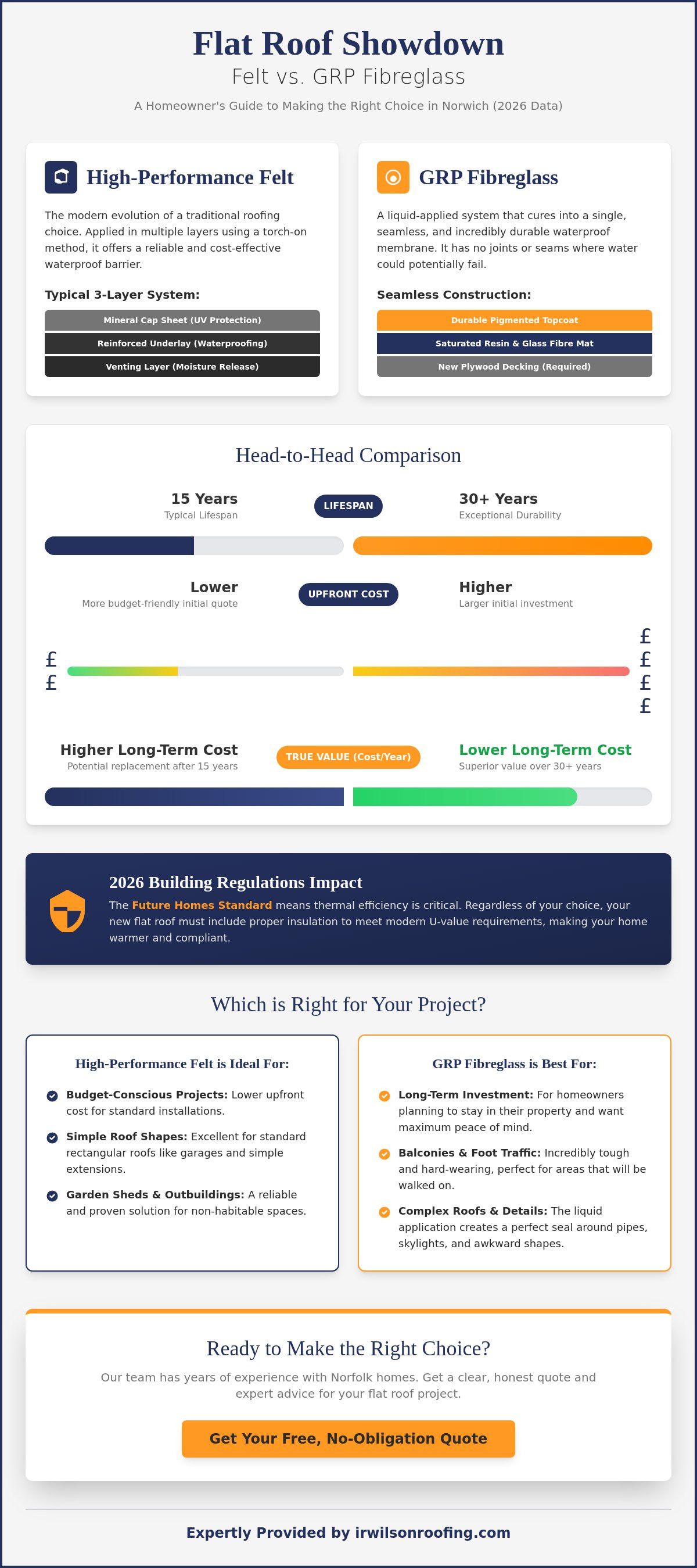
- Understand how to calculate the "cost-per-year" value by comparing a traditional 15-year lifespan against the 30-year durability of modern resin systems.
- Discover how the 2026 Building Regulations and the Future Homes Standard impact your requirements for roof insulation and thermal efficiency.
- Identify which material is best suited for your specific project, whether you are covering a simple garden shed or a complex balcony with heavy foot traffic.
Felt Roof vs GRP Fibreglass: Understanding the Basics
The choice between felt and GRP often comes down to balancing your immediate budget with how long you plan to live in your home. By 2026, the UK roofing market has evolved significantly. We no longer rely on the brittle, single-layer materials that gave flat roofs a bad reputation in decades past. Modern flat roof construction now uses sophisticated multi-layer systems or advanced resins designed to withstand the damp, coastal-influenced Norfolk climate. Whether you're looking at a garage in Sprowston or a kitchen extension in the Golden Triangle, understanding these basics helps you manage your felt roof replacement cost Norwich effectively.
With the introduction of the 2026 Future Homes Standard, we've seen a much greater focus on thermal efficiency. This means that whether you choose felt or GRP, the underlying structure and insulation layers are now more critical than ever to meet modern U-value requirements. We take great care to ensure every installation we perform complies with these updated regulations, providing you with a home that's as warm as it is dry.
To better understand how these modern systems are put together, watch this helpful video:
The Anatomy of a Modern Felt Roof
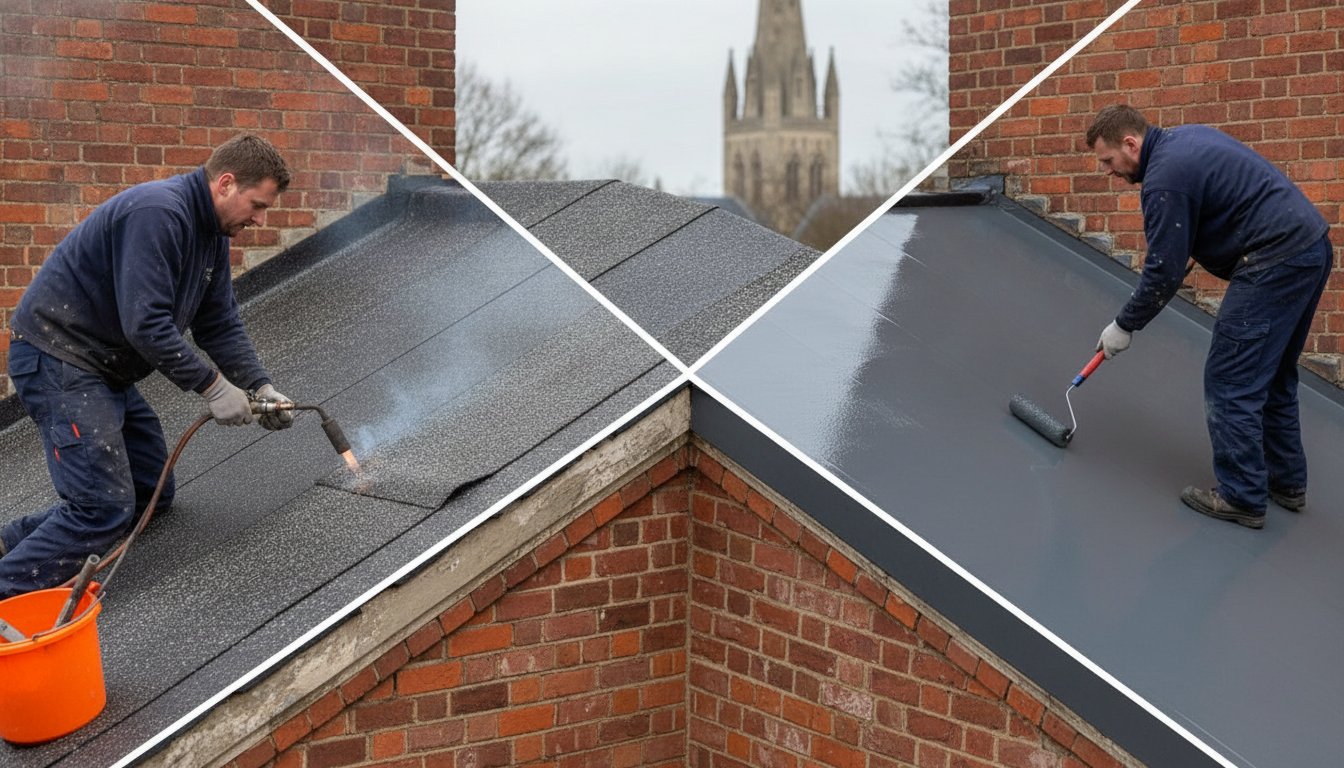
At I R. Wilson Roofing, we typically install a three-layer built-up bituminous system for our felt projects. This isn't just a single sheet of material. It's a structured approach designed for maximum protection:
- Venting Layer: This base layer allows the roof to "breathe," preventing blisters caused by trapped moisture.
- Reinforced Underlay: A high-strength middle layer that provides the primary waterproofing barrier.
- Mineral Cap Sheet: This final layer provides vital UV protection and determines the roof's final colour.
Modern bitumen is vastly superior to old "pour and roll" methods. It contains added polymers that ensure the roof stays flexible during freezing winter nights, preventing the cracks that used to cause leaks in older systems.
The Seamless Nature of GRP Fibreglass
GRP stands for Glass Reinforced Plastic. It's a liquid-applied system where we lay a glass fibre matting over a new plywood deck and saturate it with a catalysed resin. This creates a single, continuous skin without a single seam or joint. We use specialised pre-formed trims for the edges and finish with a durable, pigmented topcoat. The total lack of "hot works" or open flames makes GRP a popular choice for many homeowners who are concerned about safety. It's an incredibly tough material that can even handle light foot traffic if you're planning to use the roof as a balcony. The resulting finish is hard-wearing, aesthetically clean, and exceptionally long-lasting.
The Upfront Price Tag: Felt vs GRP Fibreglass Cost Breakdown
When you look at your first set of quotes, the gap between felt and GRP can be surprising. Generally, the felt roof replacement cost Norwich homeowners encounter is significantly lower than a fibreglass equivalent. This is because felt materials are more affordable to manufacture, and the installation process is typically faster for a standard rectangular roof. However, the initial quote rarely tells the whole story of the work involved.
Labour intensity varies greatly between the two systems. Torch-on felt is a physical, fast-paced job that involves rolling out heavy membranes and bonding them with heat. GRP fibreglass is a more methodical, multi-stage process. We have to wait for a perfectly dry window, lay the decking, apply the resin and glass matting, and finally add the pigmented topcoat. This extra time on-site naturally increases the labour portion of your bill. Both materials must meet strict Building Regulations fire safety standards, and we only use high-performance products that carry the necessary certifications for residential use.
The biggest "hidden" cost with GRP is the decking. You cannot apply fibreglass over old felt or uneven boards. It requires a brand-new, structural OSB3 tongue-and-groove timber deck to bond correctly. If your existing roof boards are in poor condition, this adds a mandatory expense to a GRP installation that might have been optional for a felt patch-up. If you're unsure which system fits your specific roof layout, you can read more about our recent local projects to see how we've tackled similar challenges for Norfolk residents.
Structural Requirements and Preparation
The condition of your existing roof timbers is the biggest "wildcard" in any quote. If we find rot in the joists once the old material is stripped back, the price will increase to cover essential timber replacement. We believe in doing the job right the first time, so we never hide these issues under new felt. Disposal also plays a part in your final quotation. Skips and waste transfer fees for heavy old bitumen and gravel add to the total, especially on larger commercial or industrial properties.
Complex Shapes and Detailing Costs
If your roof has multiple skylights, chimneys, or soil pipes, the labour for felt increases. Each penetration requires careful hand-cutting and torching to ensure a seal. GRP actually has a slight advantage here. Because it's liquid-applied, we can "paint" the waterproof membrane around awkward shapes and upstands much more easily than fitting a thick felt sheet. For large, simple flat extensions, felt offers excellent economies of scale, making it the go-to choice for many budget-conscious homeowners.
Performance in the Norfolk Climate: Longevity and Total Cost
Living in East Anglia brings a unique set of challenges for any flat roof. We experience some of the highest UV exposure levels in the UK during the summer, followed by sharp, biting frosts in the winter. These temperature swings cause roofing materials to expand and contract daily. When assessing the felt roof replacement cost Norwich contractors provide, you must look beyond the initial invoice and consider the "cost-per-year" value. A standard high-performance felt roof typically lasts between 10 and 20 years. In contrast, a professionally installed GRP fibreglass roof often exceeds 30 years of service. While you pay more today for GRP, you might find it's the cheaper option over three decades because you won't be replacing it twice.
Thermal expansion is a factor we often discuss with our clients. If a GRP roof isn't installed with the correct expansion joints or if the resin is applied too thickly, you might hear a "cracking" or "popping" sound on hot days. This is simply the material moving against the timber deck. It's rarely a sign of failure, but it highlights why expert installation is vital. According to the National Federation of Roofing Contractors (NFRC), material selection should always account for these local environmental stressors to ensure long-term structural integrity. If your roof doubles as a balcony or terrace, GRP is the clear winner. It handles the pressure of garden furniture and foot traffic far better than the relatively soft surface of a mineral felt sheet.
UV Resistance and Material Degradation
The Norfolk sun is a quiet enemy of bitumen. Over time, solar radiation dries out the oils in older felt membranes, making them brittle and prone to "alligatoring" or surface cracking. UV degradation is the chemical breakdown of roofing polymers caused by prolonged exposure to solar radiation, leading to brittleness and eventual surface failure. Modern mineral cap sheets help reflect this heat, but GRP topcoats are engineered specifically to remain stable under intense light. This ensures the roof stays waterproof even as it ages through decades of summer heatwaves.
Resistance to Wind and Storm Damage
Norwich isn't stranger to high winds, especially for properties on higher ground or near the coast. Because GRP is a seamless, liquid-applied skin that bonds directly to the timber deck, there are no edges for the wind to "catch" and lift. Felt roofs rely on bonded seams. While modern torch-on techniques are incredibly strong, those joints remain the most common point of failure during extreme storms. At I R. Wilson Roofing, we pay extra attention to the perimeter leadwork and edge trims. This creates a storm-ready seal that keeps your home dry when the Norfolk weather turns sour.
Maintenance and Repair Costs: Protecting Your Investment
Every roof requires a level of care to reach its full potential. When weighing up the total felt roof replacement cost Norwich homeowners often forget to factor in the small repairs that pop up after year ten. While felt is the more affordable system to install, it generally demands more frequent inspections to catch minor issues before they turn into internal ceiling damage. GRP fibreglass is much more of a "set and forget" system, but it still benefits from a quick annual check to ensure the perimeter trims and seals remain tight. We always tell our customers that a few pounds spent on maintenance today saves hundreds on structural repairs tomorrow.
Repairability is a key difference between these two materials. If a ladder or a fallen branch punctures a felt roof, we can often apply a high-performance patch that bonds seamlessly with the existing bitumen. GRP is incredibly tough, but if it does crack, the repair process is more technical. It requires sanding back the topcoat and applying new resin and matting. It's harder to make these repairs invisible on a GRP roof, which is why we place such a high value on the quality of the initial installation. As a family-run business, we take personal pride in every job, providing a professional guarantee that gives you the peace of mind you deserve.
Common Repairs for Felt Systems
The most frequent issues we see with older felt roofs are joint failures and solar blistering. Because felt is laid in sheets, the seams are naturally the weakest point. If the bonding agent dries out or wasn't applied with enough heat, water can creep underneath. Bubbling or blistering occurs when moisture gets trapped between the layers during installation and expands in the summer heat. If you've noticed these signs, you should look into flat roof repairs Norwich experts can handle quickly. Catching a failing seam early can extend the life of the roof by several years, delaying a full replacement.
Maintaining a GRP Roof
Maintaining a GRP roof is mostly about keeping it clean and checking for "pinholing." These are tiny holes that can form in the topcoat if it was applied too thinly or in poor weather. While GRP doesn't attract moss as easily as the rough mineral surface of felt, you should still clear away leaves and debris from the gutters. A smooth GRP surface is much easier to wash down with a soft brush and water. We recommend a professional inspection every 5 years just to check the structural integrity of the deck and the condition of the topcoat. If you want to see how we maintain these systems for local properties, you can view our latest maintenance tips on our blog.
Making the Right Choice for Your Property with I R. Wilson Roofing
Choosing between these two systems doesn't have to be a stressful process. We believe the right choice depends entirely on your specific goals for your property. If you're planning to move in the next few years or you're managing a budget-conscious renovation, a high-performance felt system is an excellent, reliable option. It provides a lower initial felt roof replacement cost Norwich residents can appreciate without sacrificing essential weatherproofing. On the other hand, if this is your "forever home" and you want a roof that will likely outlast your mortgage, GRP fibreglass is the superior investment.
To help you decide, we've summarised the best applications for each material based on our daily work across Norfolk:
- Choose Felt if: You have a simple rectangular garage or shed, you're working within a strict immediate budget, or you need a reliable short-to-medium term solution for a rental property.
- Choose GRP if: Your roof has complex shapes or multiple skylights, you intend to use the area as a balcony with foot traffic, or you want the peace of mind that comes with a 30-plus year lifespan.
The I R. Wilson Roofing Approach
Ian and Ben Wilson take a hands-on approach to every project we undertake. We don't use pushy salesmen or faceless call centres. When you contact us, you're speaking directly with the people who will be responsible for the safety and integrity of your home. We've built our reputation in the local community on transparency and a genuine pride in our craft. We'll walk you through the pros and cons of each material as they apply to your specific roof layout, whether that's a small porch or a large industrial unit. If you want to learn more about what to look for in a contractor, check out our Expert Roofers Norwich guide. This resource helps you understand the credentials and standards you should expect from any local trade professional.
Next Steps for Your Flat Roof
The next step is simple and entirely low-pressure. We offer a straightforward site survey to assess the current state of your roof. We'll check the timber deck, inspect the drainage, and provide a clear, itemised quotation that explains every penny of the investment. You won't find any hidden extras or surprise fees in our work. We take our time to perform tasks correctly the first time, ensuring your home stays dry regardless of the Norfolk weather. To get started, you can Contact I R. Wilson Roofing for a professional flat roof quote today. We look forward to helping you protect your home with a roof you can depend on for decades to come.
Secure Your Home’s Future with a Dependable Flat Roof
Deciding on the right material for your flat roof involves balancing your current budget with the long-term protection of your property. We've explored how a modern torch-on system offers a competitive felt roof replacement cost Norwich homeowners can rely on for immediate value. However, the seamless durability of GRP fibreglass provides a level of longevity that often makes it the more cost-effective choice over several decades. Both systems, when installed correctly, will keep your home dry and energy-efficient in line with the latest 2026 standards.
Our family-run team, led by Ian and Ben Wilson, has been providing expert roofing services since 1994. We are specialists in Norfolk flat roof repairs and replacements, and we've built our reputation on the recommendations of local homeowners who value our dependability. We take great pride in our craftsmanship and believe that your home deserves a roof that is built to last. If you're ready to discuss your project, we're here to provide the honest, technical guidance you need to make the right choice.
Get a Free, Fixed-Price Flat Roof Quote from Norwich Experts
We look forward to helping you find the perfect solution for your home, ensuring you have total peace of mind through every season.
Frequently Asked Questions
Is GRP fibreglass much more expensive than felt in Norwich?
Yes, the initial investment for a GRP roof is higher because the materials are more costly and the system requires a brand-new timber deck. While the upfront felt roof replacement cost Norwich homeowners see is lower, GRP often proves more economical over 30 years. You're essentially paying more today to avoid another replacement in 15 years.
How long does a modern high-performance felt roof actually last?
A professionally installed three-layer torch-on felt system typically lasts between 10 and 20 years. Its actual lifespan depends on the quality of the mineral cap sheet and regular maintenance. We've seen well-installed felt roofs in Norfolk reach the two-decade mark when they are kept clear of moss and debris.
Can I install a GRP roof over my existing felt to save money?
You cannot install GRP directly over old felt. Fibreglass resin requires a clean, structural OSB3 tongue-and-groove timber deck to bond correctly. Attempting to overlay old materials prevents a proper seal and will lead to the new roof delaminating and failing prematurely. We always strip the old roof back to the joists to ensure a solid foundation.
Which flat roof material is best for a garage in Norfolk?
Felt is usually the most practical and cost-effective choice for a standard garden garage. It provides reliable weatherproofing for a lower initial felt roof replacement cost Norwich residents often prefer for outbuildings. If your garage is a premium space or used as a home office, GRP is worth considering for its superior durability and aesthetic finish.
Is a fibreglass roof noisy when it rains compared to felt?
GRP can be slightly noisier during heavy downpours because it's a hard, resin-based surface. However, the difference is usually minimal when the roof is installed with modern insulation and solid timber boarding. If sound is a major concern for a bedroom extension, we can discuss specific acoustic insulation options to keep your home quiet.
Do I always need a new timber deck for a felt roof replacement?
You don't always need a new deck for felt, but we'll only know for sure once we strip back the old layers. If the underlying boards are soft, rotting, or sagging, we'll recommend a replacement to ensure the new membrane stays flat and bonded. A solid deck is essential for the long-term success of any waterproofing system.
What is the fire rating of GRP vs traditional bitumen felt?
Both materials must meet the BROOF(t4) fire safety rating required by UK Building Regulations. We only use high-performance bitumen membranes and fire-retardant GRP resins that have been rigorously tested to prevent the spread of flame. This ensures your property remains safe and fully compliant with modern insurance requirements.
Can you safely walk on a GRP fibreglass roof for maintenance?
Yes, GRP is exceptionally tough and is the best material choice if you need regular access for window cleaning or gutter maintenance. It doesn't soften in the summer heat like bitumen can. While you can walk on felt for occasional checks, it's a more delicate surface that can be punctured by heavy foot traffic or sharp objects.