A single strip of weathered lead is often the only thing protecting your Norfolk home from the relentless coastal rain and biting fenland winds. It's a small detail that carries a heavy responsibility, yet many homeowners feel a sense of dread when they start looking into the lead flashing replacement cost Norfolk contractors might charge. You're likely worried about being overcharged for materials you don't fully understand or finding that necessary access equipment has unexpectedly doubled your initial estimate.
We understand that property maintenance is stressful, especially when it involves technical industry terms like "lead codes" and specific British Standards. This guide provides the clarity you need to move forward with confidence. We'll explain why lead remains the gold standard for a leak-free roof, how to identify when a simple repair is no longer enough, and what factors truly influence the final price of the work. By the end, you'll have a clear picture of how our local, family-run team ensures your home stays dry and secure for decades to come through expert craftsmanship and honest service.
Key Takeaways
- Understand how lead flashing acts as the essential barrier between your roof features and tiles to prevent water ingress and structural damage.
- Get a clear breakdown of the typical lead flashing replacement cost Norfolk homeowners can expect in 2026, including material grades and specialist labour.
- Identify the key variables that influence your final quote, from building height and access requirements to the specific "lead code" required for your property.
- Learn about the step-by-step replacement process we use to ensure your new leadwork meets modern British Standards for a leak-free finish.
- Discover the long-term value of choosing a local family-run team that understands Norfolk building styles and prioritises durable, professional craftsmanship.
What is Lead Flashing and Why Does It Need Replacing?
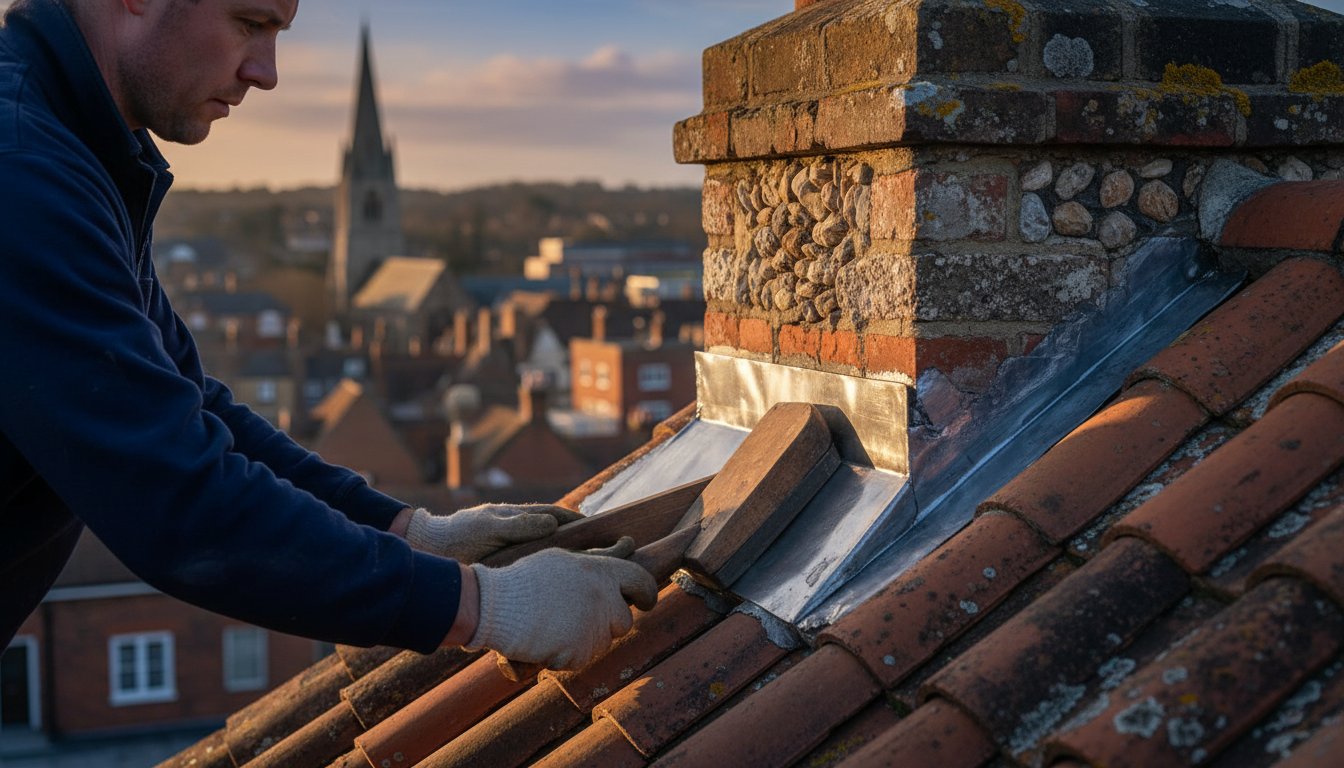
Lead flashing is the silent protector of your home's most vulnerable joints. It serves as a critical, waterproof seal between different roof features, such as a chimney stack and the tiles. Without it, water would simply run down the masonry and straight into your attic space. If you've been researching the lead flashing replacement cost Norfolk contractors provide, you likely already suspect that your existing protection is reaching the end of its life. To understand why this material is so vital, we first need to look at what is flashing? and its specific role in traditional British roofing.
In Norfolk, our roofs face everything from freezing winters to direct summer sun. Lead is a malleable metal. This makes it excellent for shaping around awkward corners. However, it also expands and contracts significantly during these temperature swings. Over several decades, this constant movement leads to fatigue. You might notice small splits or areas where the metal has thinned to the point of failure. Understanding these signs early helps you manage the lead flashing replacement cost Norfolk projects might incur before structural damage occurs.
To better understand the precision required for a professional installation, watch this helpful video:
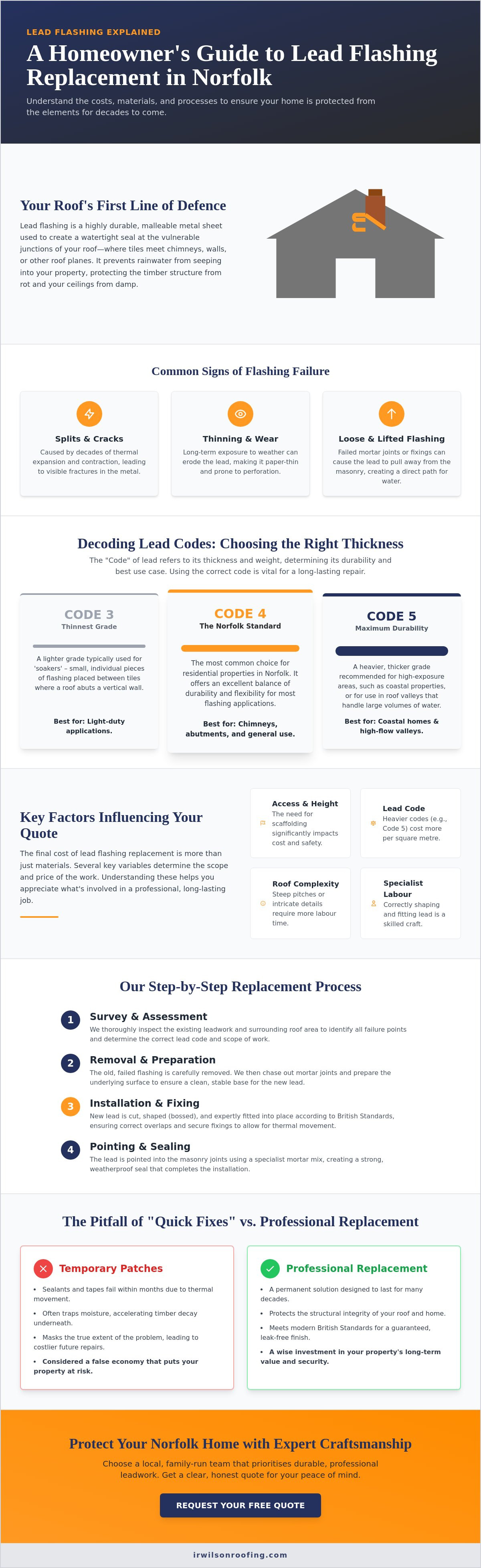
When lead fails, the consequences are often hidden. Water seeps into the roof timbers, which can lead to wet rot or internal damp on your ceilings. Common signs of failure include:
- Visible splits: Horizontal or vertical cracks caused by thermal movement.
- Thinning: Areas where the lead looks paper-thin due to long-term weathering.
- Loose "stepped" flashing: Sections of lead that have pulled away from the chimney mortar joints.
Where is Flashing Used on Norfolk Roofs?
Traditional flint cottages across the county often rely on lead around chimney stacks and abutments to bridge the gap between masonry and tile. On larger Norfolk estates, we often see it used in deep roof valleys where two slopes meet. These areas carry vast amounts of rainwater. Modern Norwich conversions also use leadwork extensively around dormer windows and skylight surrounds to keep these additions watertight against the elements.
Understanding Lead Codes (Code 3, 4, and 5)
The "Code" of lead refers to its thickness and weight per square metre. Code 3 is the thinnest and we usually reserve it for light soakers. For most residential replacements in Norfolk, we use Code 4. It provides the perfect balance of durability and flexibility. However, for high-exposure coastal properties in places like Cromer or Hunstanton, we often recommend heavier Code 5. This thicker grade stands up much better to relentless North Sea winds and harsher weather conditions.
Lead Flashing Replacement Costs in Norfolk: 2026 Estimates
Estimating the lead flashing replacement cost Norfolk homeowners face requires a clear understanding of both material values and the craft involved. In 2026, the price of lead continues to fluctuate based on global market trends, but the primary investment is usually the specialist labour required. We've found that many residents are surprised by the weight and thickness of the material needed to meet current building standards. It isn't just about laying a strip of metal; it's about following industry best practices for leadwork to ensure the joints are watertight for decades.
We often see people trying to save money by "patching" old lead with sealant or adhesive tapes. In our experience, this is almost always a false economy. These temporary fixes don't handle the thermal expansion of a Norfolk summer and often fail within months, potentially leading to costly internal damp issues. A full replacement, while a larger initial outlay, protects your home's structural integrity. The complexity of your roof pitch also plays a role. A steep, awkward angle requires more time and precision to "boss" the lead into shape, which will be reflected in your final quotation.
Typical Price Ranges for Common Leadwork Tasks
The scope of the work significantly changes the budget. A simple front apron replacement on a chimney is a relatively straightforward task for our team. However, back gutters and side "step" flashings require more intricate cutting and folding to ensure water flows away from the masonry correctly. Valley gutters, where two roof slopes meet, are often the most intensive leadwork tasks. These areas carry a high volume of water and require heavier lead codes and more time to install correctly compared to standard chimney work. If you're planning a project, you can see our latest project updates to understand how these different elements look when finished.
The "Scaffold Factor" in Replacement Costs
Safety is our priority, and for most leadwork at height, scaffolding is a legal and practical necessity. This access equipment ensures our team can work with the precision required without risk. The cost of scaffolding can sometimes represent a significant portion of the total project price, especially for three-story townhouses or homes with difficult access. To make the most of this investment, we often suggest that clients look at other necessary roof repairs while the platforms are in place. Combining leadwork with gutter cleaning or tile replacement can save you from paying for a second set of access fees later in the year.
Factors Influencing Your Final Quote in Norfolk
Every roof we survey across the county presents its own set of unique variables that can shift the final budget. While base rates provide a starting point, the specific lead flashing replacement cost Norfolk homeowners actually pay depends heavily on the property's height and physical accessibility. A simple bungalow requires far less preparation and safety equipment than a three-story Victorian terrace in the heart of Norwich. If our team needs to navigate narrow alleys, overhanging trees, or complex rooflines, the time required on-site naturally increases. We also monitor the global lead market closely. Because lead is a traded commodity, the raw material price can fluctuate between your initial enquiry and the start of the work.
The condition of your existing masonry is another vital variable we assess during our initial visit. It's often impossible to install new lead securely into perished mortar or loose brickwork. If your chimney stack is crumbling or the mortar joints have washed away, we'll need to include chimney repairs or repointing in our proposal. This ensures the new flashing has a solid "chase" or groove to sit in, which prevents water from bypassing the seal. We take pride in doing the job right the first time, which means addressing these underlying structural issues rather than just covering them up with new metal.
Heritage and Listed Building Considerations
Norfolk is famous for its architectural history, from traditional flint cottages to Grade II listed townhouses. In conservation areas, modern shortcuts simply aren't an option. We use traditional lead-burning techniques, which involves welding the joints with a gas torch rather than relying on modern adhesives that can fail under thermal stress. Conservation officers often specify exact lead codes and specific finishes to maintain the building's historical integrity. This level of specialist craftsmanship takes more time but results in a finish that respects the heritage of our local community and adds long-term value to your property.
Weather Exposure and Location
Our local geography also dictates how we approach your leadwork installation. If you live in a coastal town like Cromer or Great Yarmouth, the salt-heavy air can be more aggressive toward building materials over many years. For properties in the wind-swept fenlands, we often design deeper "laps" where sections of lead overlap. This prevents the wind from driving rain up under the flashing during a typical Norfolk storm. We always aim to schedule these replacements during settled weather windows, as opening up a roof during a North Sea gale isn't safe for your property or our team.
The Step-by-Step Leadwork Replacement Process
Every successful project starts with a methodical assessment of the task at hand. When we visit your property, we don't just glance at the roof from the ground. We take precise measurements and identify the specific "Code" required for each section of the job. As we discussed earlier, the choice between Code 4 or Code 5 is a primary driver for the lead flashing replacement cost Norfolk homeowners will see on their final estimate. We calculate exactly how much material is needed to ensure every overlap meets current British Standards, preventing water from being blown under the metal during a storm.
Our team treats every home with the same care we'd give our own. This means working steadily and following a proven process that prioritises long-term reliability over a quick fix. We believe in transparency, so we're always happy to explain each stage of the work as we progress. This methodical approach is why so many of our neighbours trust us with their most valuable assets.
Removal and Preparation
Once we've secured safe access, we begin by carefully raking out the old mortar joints. We take great care not to damage the surrounding brickwork, which is particularly important on older Norfolk homes with weathered or soft masonry. This stage is where we often uncover hidden issues. We inspect the timber "tilting fillets" and the underlying roof deck for any signs of rot. If we find that moisture has reached the wood, we can perform timber replacement right then to ensure the new leadwork has a solid, dry foundation. We also make sure the roof tiles or slates are clean and correctly positioned to receive the new seal.
Installation and Finishing
The installation stage is where true craftsmanship shows. We use a technique called "bossing" to shape the lead sheet by hand around corners and abutments. For more complex shapes, we use lead welding to create a seamless, permanent joint that won't fail under thermal stress. We secure the lead into the masonry using traditional lead wedges or stainless steel clips to prevent the metal from slipping over time. We then apply high-quality pointing to seal the lead into the masonry "chase."
The final, non-negotiable step is the application of patination oil. Without this treatment, new lead can develop an unsightly white carbonate staining that runs down your roof tiles during the first few rainfalls. The oil provides a protective coating that allows the lead to age into its classic, dull grey finish evenly. If you want to see the standard of our craftsmanship firsthand, you can read about our recent leadwork projects here.
Why Choose a Local Norfolk Specialist for Your Leadwork?
Selecting a contractor for specialist leadwork is a significant decision that affects your home's safety for decades. Unlike national corporations or faceless call centres, our family-run business relies on a reputation built over 30 years right here in the local community. When you call us, you speak directly with the owners who are responsible for the quality of every joint and weld. This direct accountability is why we provide transparent, fixed-price quotations with no hidden extras. We believe you should know exactly what the lead flashing replacement cost Norfolk contractors are quoting for before any work begins on your property.
Our deep roots in the county mean we understand local architecture intimately. Whether your home features traditional Norfolk flint, red brick, or modern materials, we know how to integrate new leadwork seamlessly. We take pride in our craftsmanship because we live and work in the same neighbourhoods as our clients. We aren't just fixing a roof; we're maintaining the heritage of our local towns and villages. This neighborly approach ensures we treat your property with the respect it deserves, from the first site survey to the final tidy-up.
The I R. Wilson Roofing Commitment
As a dedicated father and son team, we've spent decades serving the Norwich community. We've seen first-hand how "quick fixes" often lead to much larger bills down the line. That's why we prioritise long-term solutions that protect your investment. Our expertise isn't limited to metalwork; we're equally skilled in flat roof repairs and complete roof tiling. This broad knowledge allows us to spot potential issues, such as perished timber or failing felt, that a single-trade contractor might miss. We ensure your entire roof system works together to keep you dry and secure.
Getting Your Free Norfolk Roofing Quotation
We start every project with a thorough, low-pressure site survey. We'll climb up to the roof, inspect the condition of your existing lead, and check the surrounding masonry for any signs of fatigue or water ingress. This allows us to provide a detailed, fixed-price quotation that covers the total lead flashing replacement cost Norfolk residents can rely on. There are no surprises and no "estimated" fees that double once the scaffold is up. If you're worried about a leak or simply want a professional second opinion, contact us for a free leadwork inspection and quote today. We're here to help you protect your home with the honest, expert service you deserve.
Secure Your Norfolk Home with Expert Leadwork
Protecting your property from the unpredictable East Anglian weather starts with ensuring your roof's seals are in peak condition. We've seen how professional leadwork acts as the ultimate barrier against water ingress, whether you own a traditional flint cottage or a modern Norwich conversion. You now have a clearer understanding of the variables that influence the lead flashing replacement cost Norfolk homeowners can expect, from the choice of lead code to the complexity of your chimney's masonry. By focusing on quality materials and traditional installation techniques, you ensure your roof remains watertight for many years to come.
Our team has been established since 1994, and we take great pride in being specialists in Norfolk heritage leadwork. As a highly recommended local family business, we're committed to providing the honest advice and dependable service our neighbours deserve. If you've noticed signs of wear or thinning on your roof, don't wait for a leak to cause internal damage. Get a Free, No-Obligation Leadwork Quote from Our Family Team. We're ready to provide the peace of mind that comes with a secure, professionally finished roof.
Frequently Asked Questions
How long does lead flashing typically last on a UK roof?
Lead flashing is incredibly durable and can last between 60 and 100 years when fitted by a professional. Its long life makes it one of the most cost-effective roofing materials over time. Unlike modern synthetic seals that degrade in sunlight, lead withstands decades of UV exposure and temperature changes without losing its waterproof properties. We often see leadwork on older Norfolk properties that has protected the structure for over a century.
Can I replace lead flashing myself to save on costs?
We don't recommend attempting this as a DIY project because leadwork is a highly specialised craft. Working with heavy lead sheets at height requires specific safety equipment and technical skills like "bossing" or lead welding. If the flashing isn't installed with the correct overlaps or "chases," you risk serious water damage. This often leads to repairs that cost much more than the initial professional installation would have.
Is lead flashing still the best material, or are there modern alternatives?
Lead remains the gold standard for British roofing due to its flexibility and unmatched lifespan. While there are modern "lead-free" alternatives made from polymers or aluminium, they often lack the weight and malleability needed for complex rooflines. For heritage properties and listed buildings in our county, lead is usually the only material approved by conservation officers because it maintains the building's historical integrity and performance.
What is the difference between lead repair and full replacement?
A repair usually involves fixing a single small split or resealing a loose joint, while a full replacement involves removing all the old metal and installing new sheets. When calculating the lead flashing replacement cost Norfolk homeowners should consider that "patching" old, thinned lead is often a temporary fix. If the metal has reached the end of its natural life, a full replacement is the only way to ensure a leak-free home.
Why has my lead flashing turned white or powdery?
This white powder is lead carbonate, which forms when new lead reacts with moisture and carbon dioxide in the air. It's a natural process called oxidation, but it can cause unsightly streaks on your tiles. We always apply patination oil immediately after installation to seal the surface. This prevents the white powder from forming and helps the lead age into its traditional, attractive grey colour evenly over time.
Does my home insurance cover lead flashing replacement?
Standard home insurance policies generally don't cover lead replacement if the damage is caused by general wear and tear or age. However, you might be covered if the flashing is damaged during a specific event like a severe storm or a falling branch. It's always best to check your individual policy details or speak with your provider to see if they cover the costs for storm damage repairs.
How long does it take to replace chimney flashing on a standard house?
A typical chimney flashing replacement usually takes between one and two days to complete. This timeframe includes the safe removal of the old lead, raking out the mortar joints, and the precision fitting of the new lead sheets. If your property has difficult access or requires additional masonry repairs, the process might take slightly longer. We always take the time necessary to ensure every joint is perfectly sealed.
Do I need a specialist leadworker or can any roofer do it?
While many roofers can lay basic strips of lead, complex areas like valleys and chimney saddles require a specialist with lead-burning skills. Our team has decades of experience in these traditional methods, ensuring every joint is welded rather than just glued with modern adhesives. Choosing a specialist ensures your leadwork meets current British Standards and provides the long-term protection your home needs against the elements.