Could a small damp patch in your upstairs ceiling be the first sign of a failing roof valley, or are you just one heavy downpour away from a major structural headache? We know that discovering a leak is stressful, especially when you're worried about hidden costs or being pressured into work you don't actually need. It's a common concern for many of our neighbors who want to protect their homes without overspending. Understanding the current roof valley repair cost UK homeowners face is the first step toward regaining your peace of mind and ensuring your property stays dry and secure.
You're likely looking for honest answers about whether to patch up a minor leak or invest in a full replacement. We've put together this 2026 guide to help you navigate these decisions with confidence. You'll discover how different materials like traditional lead and modern GRP impact your budget, along with the typical labor rates involved in professional roofing work. We also explain how the latest energy efficiency regulations might affect your project if you're refurbishing a larger section of your roof. This guide gives you the knowledge to find a reliable local roofer who values quality as much as you do.
Key Takeaways
- Understand why the roof valley is your property's most vital drainage channel and how to identify the early warning signs of a failing seal.
- Compare the benefits of traditional leadwork against modern GRP systems to find the most durable and cost-effective material for your specific roof.
- Discover how factors like scaffolding and roof access can influence the final roof valley repair cost UK contractors provide in their estimates.
- Learn to identify the "false economy" of minor patches and determine when a full replacement is the only way to protect your home's structural integrity.
- Find out why choosing a local, family-oriented roofing specialist ensures the personal accountability and expert craftsmanship your home deserves.
What is a Roof Valley and Why Do They Leak?
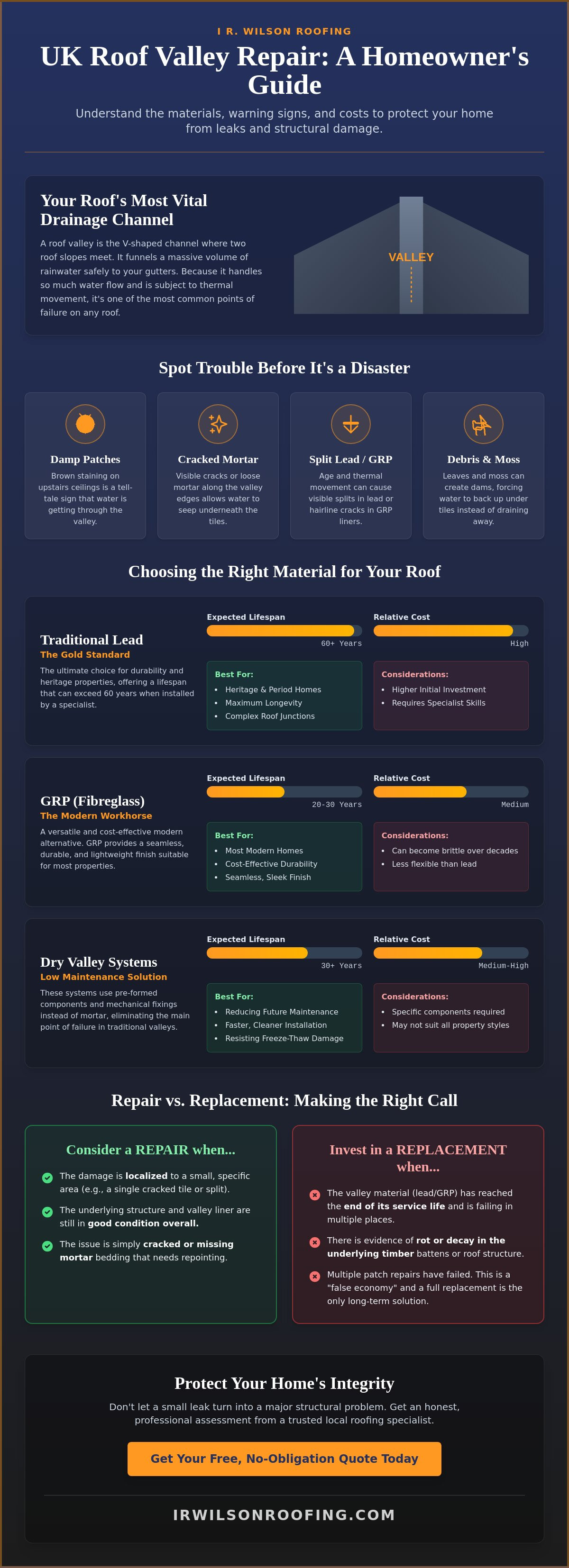
A roof valley is the internal angle formed where two different roof slopes meet. When looking at domestic roof construction, you can think of the valley as a primary drainage highway. During a heavy UK downpour, these channels handle a massive volume of water, funneling it safely toward your guttering system. Because they sit at the lowest point of the roof junction, they're under constant pressure from the elements. This makes them one of the most vulnerable areas on any property.
While traditional pitched valleys are straightforward, some homes feature complex junctions where multiple roof sections converge. These areas often fail because materials like lead or GRP expand and contract as temperatures change. Over time, this thermal movement causes minor cracks or pulls the flashing away from the tiles. Understanding these vulnerabilities helps you anticipate the potential roof valley repair cost UK homeowners might face when regular maintenance is deferred.
To better understand how these components function and why they might fail, watch this helpful video:
Common Signs of Valley Failure
You don't always need to climb a ladder to spot trouble. Start by checking your upstairs ceilings for damp patches or brown staining near the corners where your roof sections join. If you can safely view your roof from the ground, look for loose or cracked mortar bedding along the edges of the valley. For those with lead-lined valleys, visible splits or "buckling" in the metal are clear indicators of age. GRP liners might show signs of thinning or hairline cracks after decades of exposure to the sun.
The Impact of Debris and Moss
Debris is the silent enemy of a dry home. When leaves, twigs, or silt build up in these channels, they create a damming effect. This causes water to "back up" under your tiles or slates rather than flowing away. Moss is particularly troublesome because it retains moisture like a sponge. This constant dampness accelerates the decay of the mortar used to bed the valley tiles. We've seen many cases where simple, regular gutter cleaning could have prevented a much larger repair bill. Keeping these channels clear ensures water moves quickly off your property, reducing the likelihood that you'll need to worry about a rising roof valley repair cost UK estimate.
Roof Valley Materials: Lead, GRP, and Dry Valley Systems
Choosing the right material for your roof valley is a balance between your property's architectural style and your long-term budget. While lead has been the standard for centuries, modern alternatives like GRP (Glass Reinforced Polyester) and dry fix systems are becoming increasingly popular. Your choice directly influences the roof valley repair cost UK contractors will quote, as well as how many decades of service you can expect before needing another intervention. We often find that for many Norfolk homes, the decision comes down to the age of the building and the specific pitch of the roof slopes.
A significant shift in recent years is the move away from traditional mortar-bedded valleys toward "Dry Valley" systems. In a traditional setup, mortar is used to seal the gap between the tiles and the valley liner. However, mortar is prone to cracking due to the UK's freeze-thaw cycles. Dry valley systems use mechanical fixings and pre-formed profiles to create a water-tight seal without any cement. These systems are faster to install and require far less maintenance over a 30-year period. Following NFRC roofing standards ensures that whichever system you choose is installed to withstand the specific wind and rain loads common in our region.
Traditional Lead Valleys
Leadwork remains the gold standard for heritage properties and period homes in Norwich. If it's installed correctly with the proper "steps" and expansion joints, a lead valley can easily last 60 years or more. It's a highly flexible material, which allows us to create bespoke seals around complex roof junctions that pre-formed materials can't match. While the initial investment is higher than synthetic alternatives, the long-term ROI is excellent because you won't be looking at a replacement for several generations. It's a traditional craft that we take great pride in maintaining for our local clients.
Modern GRP and Pre-formed Valleys
For modern residential repairs and new builds, GRP is often the preferred choice. These pre-formed liners are incredibly lightweight, durable, and completely resistant to UV damage. They don't have the scrap value of lead, which can be a consideration in some areas, and they're much faster to fit. This speed of installation can help keep your total roof valley repair cost UK estimates lower by reducing the hours spent on the scaffolding. GRP is particularly effective for straightforward, long runs where a consistent, clean finish is required. If you're unsure which material suits your home, you can read more about our approach to durable roof repairs to see how we match materials to specific property needs.
- Lead: Best for heritage aesthetics, maximum longevity, and complex shapes.
- GRP: Cost-effective, quick to install, and ideal for modern homes.
- Dry Fix: Eliminates mortar failure and reduces long-term maintenance requirements.
Breaking Down Roof Valley Repair Cost in the UK
Estimating a roof valley repair cost UK wide involves looking at more than just the price of lead or GRP. Every home has a different story, and the complexity of your roof design plays a major role in the final quote. While minor repairs might only take a few hours of focused work, a full replacement is a more involved process that requires careful planning and safe access. We often find that the biggest variable isn't the material itself, but how easily our team can reach the affected area. Understanding the factors behind the roof valley repair cost UK homeowners see on their quotes helps you avoid any unexpected surprises when the final bill arrives.
Scaffolding is frequently the most significant cost driver in any roofing project. Because the client business does not provide scaffolding rental, we recommend budgeting for this as a separate but essential component of the work. For a standard semi-detached or detached home, you can expect scaffolding hire to range between £250 and £800 per week. This ensures the safety of the craftsmen and protects your property during the works. If your valley is located in a particularly awkward spot or at a significant height, these access costs will naturally increase. Prices in the East of England tend to be more stable compared to the higher premiums often found in London and the South East.
Labour Rates and Project Timescales
A standard valley replacement typically takes between 6 and 8 hours for a professional team to complete. Minor repairs, such as repointing mortar or patching small cracks, usually require 4 to 6 hours of work. Labor rates vary across the country, but they reflect the level of expertise and insurance required to work at height safely. Hiring a local roofing specialist is often the most efficient route. Local teams understand the specific weather challenges in Norfolk and can often provide more accurate timescales based on their familiarity with regional building styles.
Additional Hidden Costs to Consider
When we open up a roof valley, we sometimes find that the issues go deeper than the surface liner. If water has been leaking for a long time, the timber battens or the underlay felt may have started to rot. Replacing these essential structural components adds time and materials to the project. You should also consider the cost of waste disposal for old materials, especially if you're removing heavy lead or large amounts of debris. Finally, if the leak has reached your interior, remember to budget for "making good" any damaged plasterwork or paint on your ceilings once the roof is watertight.
Repair vs. Replacement: Making the Right Decision
Deciding between a quick fix and a total overhaul is often the most difficult part of property maintenance. While a temporary sealant might seem like a budget friendly choice, it often represents a "false economy." These quick fixes tend to mask deeper issues, leading to a higher total roof valley repair cost UK homeowners pay when the underlying problem inevitably worsens. We believe in giving you the straight facts so you can make an informed choice for your home's future. A patch repair is really only a viable short term solution if the valley is relatively new and has suffered minor, localized damage from a fallen branch or a single slipped tile.
When we assess your roof, we look closely at the state of the surrounding tiles and the mortar bedding. If the cement is crumbling along the entire length of the join, a small patch won't stop the next leak from appearing just a few feet away during the next storm. Choosing a full replacement is often the most cost effective strategy over a 10 year period. It provides a clean slate and ensures that every component, from the liner to the fixings, is performing at its best. This proactive approach saves you the stress of repeated call outs and the cumulative costs of multiple small repairs.
The 50% Rule for Roof Repairs
A simple way to decide is to use the 50% rule: if the quoted repair costs reach 50% of the price of a full replacement, we always recommend choosing the replacement. This logic protects your investment and ensures you aren't throwing good money after bad. We also evaluate the age of the roof as a whole. A new valley can significantly increase property value and buyer confidence, as it demonstrates that the home has been meticulously maintained. It's a digital handshake that tells a surveyor the property is watertight and structurally sound.
Inspecting the Underlying Timber
One area that many guides overlook is the condition of the valley boards beneath the liner. When a valley leaks, water often sits on the timber support structure, which can lead to wet rot or structural softening. If we find "soft" spots during a visual inspection, it's a clear sign that the damage has moved beyond the surface. Professional timber replacement must happen before a new lead or GRP liner is installed to ensure the roof remains stable. Ignoring these structural issues is a risk that can lead to sagging and much more expensive repairs down the line. If you're currently weighing up your options, you can explore our expert roofing advice to help you choose the most reliable path for your property.
Professional Roof Valley Services in Norwich and Norfolk
Choosing a family-run business like I R. Wilson Roofing means you're getting more than just a technical service. You're getting the personal accountability and heritage that comes from a team deeply rooted in the local community. We take immense pride in our craftsmanship, whether we're installing modern GRP liners or performing intricate traditional leadwork on a period home. Our goal is to provide a sense of calm competence that alleviates the stress of property maintenance. We believe that a fair and transparent roof valley repair cost UK homeowners can rely on starts with an honest, face-to-face conversation about what your property actually needs.
Unexpected weather is a reality in our part of the world. We're always ready to handle emergency storm damage repairs across the Norfolk region to ensure your home remains protected after a heavy gale. Because we manage our own projects directly, we don't use the high-pressure sales tactics often associated with larger, faceless corporations. Instead, we focus on providing fixed-price, competitive quotations and expert advice that prioritizes the long-term safety of your roof. This hands-on mentality ensures that the person you speak with on the phone is the same professional who understands the specific requirements of your project.
Local Knowledge for Norfolk Properties
The Norfolk climate presents unique challenges for roof drainage, especially for properties exposed to coastal winds and damp North Sea air. Our team has extensive experience working with the traditional flint and brick properties that define the character of Norwich. We understand how these materials interact with modern roofing systems and how to ensure a watertight seal that respects the building's heritage. A local reputation matters because it's built on years of successful projects and personal recommendations. Unlike generic online directories, our commitment to enduring quality serves as a digital handshake and a promise that we'll be here to support you for years to come.
Get a Professional Assessment Today
We begin every project with a thorough, no-pressure valley inspection. Our craftsmen look beyond the surface to identify the root cause of any leaks, ensuring we provide a solution that lasts rather than a temporary patch. We'll provide you with a detailed written quote that clearly outlines all material and labor requirements, so you know exactly what to expect. This transparency is a core part of our service-first philosophy. If you're concerned about a leak or want to ensure your roof is ready for the winter months, we're here to help. Contact I R. Wilson Roofing for a professional quote and experience the peace of mind that comes from working with a seasoned local specialist.
Secure Your Home Against the Elements
Taking care of your roof valley is about more than just stopping a leak; it's about protecting the structural integrity of your entire property. We've explored how material choices and access requirements shape the final roof valley repair cost UK homeowners can expect in 2026. Whether you opt for the century-long durability of lead or the modern efficiency of GRP, the most important factor is a correct, professional installation. We've seen how ignoring small signs of wear or relying on temporary sealants can lead to avoidable timber rot and higher long-term expenses.
As a family-run business established in 1994, our team at I R. Wilson Roofing brings decades of experience to every project. We are expert leadwork specialists who value the safety and longevity of your home above all else. If you're ready to move forward with a durable solution, we invite you to Get a Competitive Roof Repair Quote in Norwich today. Our methodical approach ensures your repairs are done right the first time, providing you with the peace of mind you deserve. Your home is your biggest investment, and we're here to help you keep it dry and secure for many years to come.
Frequently Asked Questions
Is a leaking roof valley an emergency?
A leaking roof valley is generally treated as an urgent repair because it serves as the main drainage channel for your roof. If water penetrates this area, it can quickly saturate insulation and cause rot in the structural timber. We recommend addressing any damp patches immediately to prevent a minor issue from turning into a much larger project. Catching it early helps keep the total roof valley repair cost UK homeowners face much lower.
How long does it take to replace a roof valley?
A standard roof valley replacement typically takes between 6 and 8 hours for a professional team to complete. This timeframe includes removing the old tiles, stripping out the failed liner, and installing the new lead or GRP system. Minor repairs or repointing work are usually quicker, often finished within 4 to 6 hours. These timescales can vary depending on the pitch of your roof and how easily our team can access the work area.
Can I replace a roof valley myself to save on costs?
We don't recommend attempting a DIY valley replacement because it is one of the most technically demanding parts of a roof. Getting the water-tight seal wrong can lead to significant internal damage that far outweighs any initial savings. Professional roofers have the specific training to handle lead welding or GRP fitting safely at height. It's better to rely on an experienced specialist to ensure your home remains dry and structurally sound.
Do I need scaffolding for a roof valley repair in the UK?
Most roof valley repairs require scaffolding to ensure the safety of the craftsmen and to comply with UK health and safety regulations. Working in the "valley" of a roof is physically demanding and requires a stable platform that ladders simply cannot provide. While scaffolding adds to the project's logistics, it protects your property from accidental damage during the repair process. You should check with your contractor to see how they plan to manage safe access.
What is the best material for a roof valley replacement?
The best material depends on your property's age and your specific budget. Lead remains the gold standard for longevity, often lasting over 60 years, and it is the preferred choice for heritage homes in Norfolk. Modern GRP is an excellent, cost-effective alternative for contemporary houses because it's lightweight and quick to install. We often suggest dry fix systems for newer builds to eliminate the maintenance issues associated with traditional mortar.
How much does it cost to re-mortar a roof valley?
Re-mortaring costs vary based on the length of the valley and the amount of old cement that needs to be removed. This task involves carefully lifting the edge tiles, clearing out the failed mortar, and bedding them back down with a fresh mix. It's often more economical to combine this work with other maintenance, such as gutter cleaning. We provide detailed, fixed-price quotes after a visual inspection to ensure you have an accurate figure for your specific roof.
Will insurance cover the cost of a leaking roof valley?
Home insurance typically covers repairs if the damage was caused by a sudden, external event like a severe storm or a fallen tree. However, most policies won't pay out for leaks caused by general wear and tear or a lack of regular maintenance. It's important to check your specific policy wording regarding gradual deterioration. We can provide the necessary documentation and photos of the damage to assist you if you decide to make a claim.
How long should a new lead roof valley last?
A professionally installed lead roof valley can last between 60 and 100 years. Its longevity comes from its natural resistance to UV light and its ability to expand and contract without cracking, provided expansion joints are used. This incredible lifespan makes it one of the most durable materials available for domestic roofing. While the initial roof valley repair cost UK residents pay for lead is higher, the long-term value is unmatched by synthetic alternatives.