
During a heavy coastal downpour, the last thing you want to spot is a dark water stain creeping down the wall where your extension joins the house. When dealing with lean-to roof repair Norfolk homeowners often find that persistent leaks stem from failed lead flashing at this brickwork junction rather than simple surface wear.
It's exhausting to watch temporary sealant patches fail every winter, especially when you're left guessing whether you need a quick felt repair or extensive timber replacement. In this guide, you'll discover how to pinpoint the true cause of water ingress, tackle low-slope ponding, and protect your ceilings from structural damage. We'll walk you through the most dependable fixes and explain how our family team can assist with a free consultation for honest, affordable guidance.
Key Takeaways
- Pinpoint the root causes of water ingress along wall junctions, especially where East Anglian coastal winds drive rain past worn mortar.
- Discover how durable stepped leadwork and torch-on bitumen felt provide the long-lasting fix for lean-to roof repair Norfolk properties need.
- Understand the critical warning signs that reveal whether a targeted patch will work or if underlying roofline timber replacement is required.
- Learn what a comprehensive roof survey covers and how booking a free consultation ensures an honest, affordable assessment from a trusted family team.
Diagnosing Lean-To Roof Problems Across Norfolk Properties
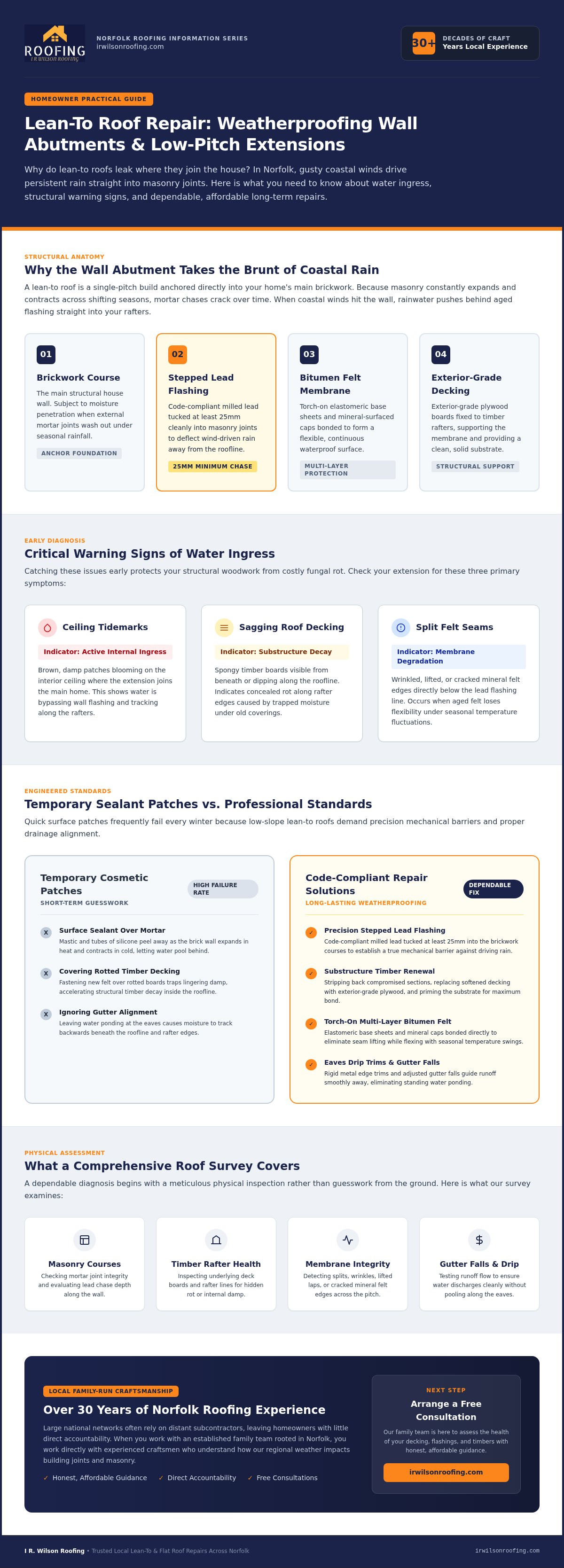
A lean-to structure relies entirely on a sturdy connection to your existing property wall. For homeowners wondering what is a lean-to roof?, it is a single-pitch build anchored directly into the main brickwork. Because of this design, the junction where the roof meets the wall takes the brunt of the elements. Across our region, gusty East Anglian coastal winds drive persistent rain straight against these brick faces, pushing moisture beneath aging lead flashing joints and washed-out mortar.
To see how these timber rafters and wall junctions fit together on a typical build, watch this helpful breakdown:
When weather barriers along the abutment deteriorate, moisture quickly migrates into the supporting structure. Addressing the lean-to roof repair Norfolk properties frequently need starts with identifying whether water is entering through split mineral felt or behind the wall joint itself.
Common Signs of Water Ingress at the Wall Abutment
Masonry expands and contracts across shifting seasons, causing older mortar chases to crack. Once this seal breaks, rainwater bypasses the flashing and runs directly down the rafter lines. Watch for these telltale signs of water travel:
- Ceiling tidemarks: Brown, damp patches blooming on the interior ceiling where the extension joins the main home.
- Sagging roof decking: Spongy timber boards visible from beneath, signaling concealed rot along rafter edges.
- Split felt seams: Wrinkled, lifted, or cracked mineral felt edges directly below the lead flashing line.
Catching these early warnings protects your structural woodwork from costly fungal rot. If you notice signs of damp along your junction wall, our team is glad to provide a free consultation to assess the health of your decking and timbers.
Effective Repair Solutions for Weatherproof Lean-To Roofs
Stopping persistent moisture requires solutions tailored to low-slope designs rather than quick cosmetic patches. For enduring lean-to roof repair Norfolk homes require precision stepped lead flashing chased cleanly into the masonry joints. Our repairs strictly adhere to professional roofing standards, replacing failed mortar seals with code-compliant milled lead tucked at least 25mm into the brickwork courses. This mechanical barrier prevents wind-driven rain from creeping behind the abutment, keeping your interior dry year after year.
Before applying any surface coverings, inspecting the substructure is vital. Fastening new materials directly over rotted decking traps moisture, accelerating timber decay. We carefully strip back compromised sections, replace weakened timber boards with exterior-grade plywood, and prime the substrate to ensure an enduring bond.
Restoring Mineral Felt and Underlay on Low-Pitch Extensions
Modern multi-layer bitumen felt delivers an affordable, robust barrier against our region's wet winters. A professional torch-on system bonds elastomeric base sheets and mineral-surfaced caps directly to the prepped timber deck. This continuous membrane eliminates seam lifting while easily flexing with seasonal temperature swings.
- Eaves drip edges: We form rigid metal edge trims that guide runoff directly into your gutters rather than allowing it to track under the roofline.
- Gutter alignment: Adjusting gutter falls prevents standing water at the eaves, ensuring heavy downpours clear smoothly.
- Comprehensive detailing: For a closer look at multi-layer methods, explore our complete guide to flat roof repairs Norwich.
If your extension is struggling with standing water or degraded seams, explore our dedicated flat roof repairs to arrange a free consultation and get an honest, lasting fix for your property.
Choosing Professional Lean-To Roofing Repairs in Norfolk
Hiring a contractor shouldn't feel like a gamble. Large national networks often rely on distant subcontractors, leaving homeowners with little direct accountability when issues arise. Opting for an established, family-run team rooted in Norfolk means you work directly with the craftsmen responsible for your home. With over 30 years of hands-on local trade experience, we know how regional weather impacts building joints and masonry.
A dependable diagnosis begins with a meticulous physical inspection rather than guesswork from the ground. When evaluating a property for lean-to roof repair Norfolk homeowners benefit from an assessment that checks timber rafters for internal damp, tests gutter fall angles, and inspects the structural integrity of fascias and soffits. Catching sub-surface rot early keeps your living space secure while avoiding costly structural overhauls down the road.
The Advantage of an Honest, Independent Roof Survey
Not every leak demands an entire roof teardown. Honest tradespeople clearly differentiate between isolated flashing faults that need targeted repointing and widespread degradation that calls for a full surface replacement. You deserve clear, itemized written quotations that detail every stage of the work, eliminating surprise costs or aggressive sales tactics.
Every home deserves dependable, transparent care. Homeowners across the area are invited to contact I R. Wilson Roofing to book a friendly, free consultation. As a local father-and-son team, we take genuine pride in offering straightforward advice and durable, affordable workmanship that keeps your extension dry through every season.
Protect Your Home with Dependable Lean-To Repairs
Resolving persistent water ingress starts with pinpointing issues at the brickwork junction before internal ceilings suffer. Whether your property requires newly stepped lead flashing, rotten timber deck replacement, or multi-layer bitumen felting built for East Anglian weather, early repairs keep your living space safe and warm. For dependable lean-to roof repair Norfolk homeowners can rely on our family business, bringing over 30 years of local heritage and the direct, hands-on supervision of Ian and Ben Wilson to every project.
Take the first step today to secure your property with an honest, affordable assessment and keep your extension completely weatherproof for years to come.
Frequently Asked Questions
What causes a lean-to roof to leak where it joins the house wall?
Leaks where a lean-to roof joins the exterior wall are almost always caused by failed lead flashing or cracked mortar joints. As temperature changes cause the two connecting structures to expand and shift independently, old mortar breaks down. Driving rain running down the exterior masonry finds these gaps and enters the roof space, damaging rafters and ceiling plasterboard.
Can a leaking felt lean-to roof be repaired without replacing the entire roof?
Yes, a leaking felt roof can often be resolved through targeted repairs rather than a full replacement. When carrying out lean-to roof repair Norfolk professionals check whether the underlying timber decking remains firm and dry. If the rafters are solid, an affordable torch-on bitumen overlay can reseal isolated splits and seams, extending your roof's lifespan without unnecessary expense.
How long does a professional bitumen felt repair on a lean-to roof last?
A high-performance torch-on bitumen repair can easily last between 15 and 20 years when installed correctly. Modern multi-layer mineral felt is designed to withstand harsh weather, flexing naturally with temperature shifts rather than cracking. Ensuring correct leadwork abutments and clean gutter drainage protects the repair against standing water and premature wear.
Do I need planning permission to repair or re-pitch a residential lean-to roof in Norfolk?
Most lean-to roof repairs fall under permitted development and do not require planning permission. Replacing more than 25% of the roof structure, however, does require Building Regulations approval to verify proper insulation standards. Properties in conservation zones, listed buildings, or homes under the Norfolk Broads Authority will also need direct clearance from local planning authorities before major changes.