Last November, following a relentless North Sea gale, a homeowner in Thorpe St Andrew found three cracked clay pantiles sitting in their guttering. It's a common sight across Norfolk, but it often triggers a wave of anxiety about potential leaks and the daunting cost of repairs. We understand that your home is your most significant investment, and the thought of hiring a roofer can feel overwhelming. You want to avoid the "cowboy" tradesmen who overcharge and instead find a reliable, family-run team that treats your property with genuine care and professional expertise.
This guide simplifies the process of roof tile replacement in Norwich by explaining exactly how to identify damage and choose materials that suit our unique local architecture. We'll help you decide between a minor repair and a full replacement so you can make an informed, confident decision for your property. We will walk you through the technical differences between concrete and clay tiles, the specific impact of Norfolk's coastal climate, and how our long-term guarantees provide the peace of mind you deserve for years to come.
Key Takeaways
- Identify early warning signs of failure, from slipped tiles to loft dampness, to protect your property’s structural integrity.
- Compare the durability and weight requirements of clay, concrete, and slate to ensure your chosen material suits your home's unique character.
- Apply the "20% rule" to determine if a reactive repair or a full roof tile replacement Norwich is the most sensible investment for your budget.
- Understand the professional installation sequence, including essential safety measures and the critical inspection of your roof's timber rafters.
- Learn the benefits of choosing a local, family-run specialist for "boots-on-the-ground" expertise and guaranteed long-term reliability.
Signs You Need Roof Tile Replacement in Norwich
Identifying the need for roof tile replacement Norwich homeowners can trust starts with a simple walk around your property. We often find that major issues are visible from the pavement if you know what to look for. You should check for slipped, cracked, or missing tiles, especially after the high winds we typically see in East Anglia. If you can see the dark grey of the underlying felt or the timber battens, your home is already at risk of water ingress.
To see how a professional identifies and manages these common issues, watch this helpful video:
Internal warning signs are just as critical. We recommend checking your loft space for damp patches on the rafters or light peeking through the roof structure. Ceiling discolouration in your upper floors is a late-stage symptom that suggests a tile has been compromised for some time. Another reliable indicator is the "sand on the drive" test. If you find heavy deposits of grit in your gutters or on the ground, it means your tiles are losing their protective surface. The history and materials of roof tiles show that once this mineral layer erodes, the tile becomes porous and prone to failure.
Norwich Architecture and Common Roofing Issues
The age of Norwich’s housing stock plays a huge role in roof health. Many terrace homes in areas like the Golden Triangle date back to the Victorian (1837-1901) or Edwardian (1901-1910) eras. These properties often use traditional Norfolk pantiles. While beautiful, these clay tiles can delaminate after a century of exposure. Dealing with shared chimneys and party walls requires a careful hand; a leak on your neighbour’s side of a shared terrace can often migrate across the roofline. Modern concrete alternatives are heavier, so we always ensure your existing roof structure can support the weight before we begin any roof tile replacement Norwich project.
The Impact of the Norfolk Climate on Your Tiles
Our local climate is particularly brutal on roofing materials. Norwich sits roughly 20 miles from the North Sea, meaning salt-laden air can accelerate the corrosion of old iron tile nails. Norfolk also experiences significant rainfall, with some years exceeding 700mm of precipitation. This moisture encourages heavy moss growth. When winter temperatures drop, the water trapped in this moss freezes and expands. This "freeze-thaw" cycle causes frost heave, which can snap the nibs off older clay tiles and leave them sliding down your roof. As a family-run business, we've seen how these specific local conditions can turn a small crack into a major leak during a single winter season.
Choosing the Right Materials for Your Norfolk Home
Selecting the correct material for your roof tile replacement Norwich project involves more than just picking a colour you like. We consider the structural integrity of your timber rafters alongside the architectural heritage of your specific street. The Norwich skyline is a unique blend of medieval flint, Victorian brickwork, and mid-century expansion, meaning a one-size-fits-all approach doesn't work here. We help you balance the weight of the tiles with the aesthetic requirements of your neighbourhood.
Weight is a primary technical concern. A standard concrete tile typically weighs about 50kg per square metre, which is often 15% heavier than traditional clay pantiles. If your home was originally built for lighter materials, we must assess whether your roof structure needs reinforcement before the new tiles arrive. Beyond the tiles themselves, we always install high-performance breathable membranes that meet BS 5534 standards. These modern underlays allow moisture to escape from your loft space while providing a secondary line of defence against the driving rain we often see sweeping in from the North Sea; for broader technical insights into such systems, you can explore Pitched Roofing via Archers Roofing Services Ltd.
Getting the colour match right is essential for maintaining your property's value. We look at the weathered tones of surrounding buildings to ensure your new roof doesn't look out of place. Whether you need a deep granular red or a smooth slate grey, we source materials that age gracefully over the coming decades. If you aren't sure which material suits your budget, we provide a free, no-obligation estimate to help you compare the long-term benefits of each option.
Clay Pantiles: The Traditional Norfolk Favourite
The classic "S" shaped Norfolk pantile is a staple of our local landscape. These tiles offer an unmatched lifespan, often lasting 60 to 100 years when installed correctly. While the initial investment is higher than concrete, the natural pigments in clay never fade; they actually grow more attractive as they weather. For heritage properties in the city centre or conservation areas like the Golden Triangle, we often recommend reclaimed clay tiles to maintain a seamless, historic appearance.
Concrete Tiles: Modern Durability for Norwich Suburbs
Concrete is the most common choice for 20th-century homes in suburbs like Hellesdon, Sprowston, and Thorpe St Andrew. It is a cost-effective, incredibly durable option that performs well in the UK climate. Modern concrete tiles come in a vast range of profiles that can mimic the look of natural slate or clay at a fraction of the price. You can expect a high-quality concrete roof to remain functional and secure for at least 40 to 50 years with minimal maintenance beyond occasional gutter clearing and moss checks.
Roof Tile Repair vs. Full Replacement: A Decision Guide
Deciding whether to patch a leak or invest in a full roof tile replacement Norwich homeowners often find stressful. We use the "20% rule" as a professional benchmark. If more than 20% of your tiles are cracked, porous, or slipping, the roof has likely reached its natural end of life. At this point, individual repairs become a game of "whack-a-mole." You might spend £300 this month on a leak, only for another to appear six inches away after the next frost. Over a three-year period, these reactive costs often exceed 40% of the price of a full re-roof, without providing any long-term security.
It isn't just about the tiles you see. The structural health of your roof depends on the timber battens and the underlay, or felt, beneath. If your home was built before 1980, it likely uses bitumen felt which becomes brittle and tears over time. Once the felt fails, even a single slipped tile can lead to significant timber rot. Replacing the tiles allows us to install modern breathable membranes and treated tanalised battens, providing a fresh 50-year lifespan for the structure.
Future-proofing your home also has a tangible impact on its market price. According to local property data, a well-maintained roof can add between 5% and 10% to a home's valuation in the Norfolk area. It gives buyers confidence that they won't face immediate capital expenditure after moving in. We find that a new roof is often the deciding factor in a smooth survey process.
When a Simple Repair is Sufficient
Isolated issues don't always require a total overhaul. If a recent gale has dislodged a handful of tiles but the rest of the roof remains tight and level, a targeted fix is the right choice. We often find that "leaks" are actually caused by perished leadwork around chimneys or valleys rather than the tiles themselves. You can refer to our guide on roof repairs in Norwich for more on these minor fixes.
The Case for a Complete Tile Replacement
If your tiles are sliding out of place across the whole pitch, you're likely facing "nail fatigue." This happens when the original galvanised nails have rusted away, leaving nothing to hold the tiles in place. Choosing a full roof tile replacement Norwich also allows us to upgrade your loft insulation to current building regulation standards of 270mm. This reduces heat loss through the roof by up to 25%. Most importantly, a new roof with a guaranteed warranty ensures your home is protected for decades.

The Professional Roof Tile Replacement Process
We follow a disciplined, five-step method for every roof tile replacement Norwich project to ensure your home stays dry and secure for decades. Our team approaches each property with the same care we would give our own family homes. This methodical pace allows us to identify hidden issues, such as rot or structural sagging, before they become expensive emergencies.
- Step 1: Scaffolding and site safety: We install independent scaffolding that meets all Health and Safety Executive (HSE) standards. This protects our team and prevents debris from damaging your windows or garden.
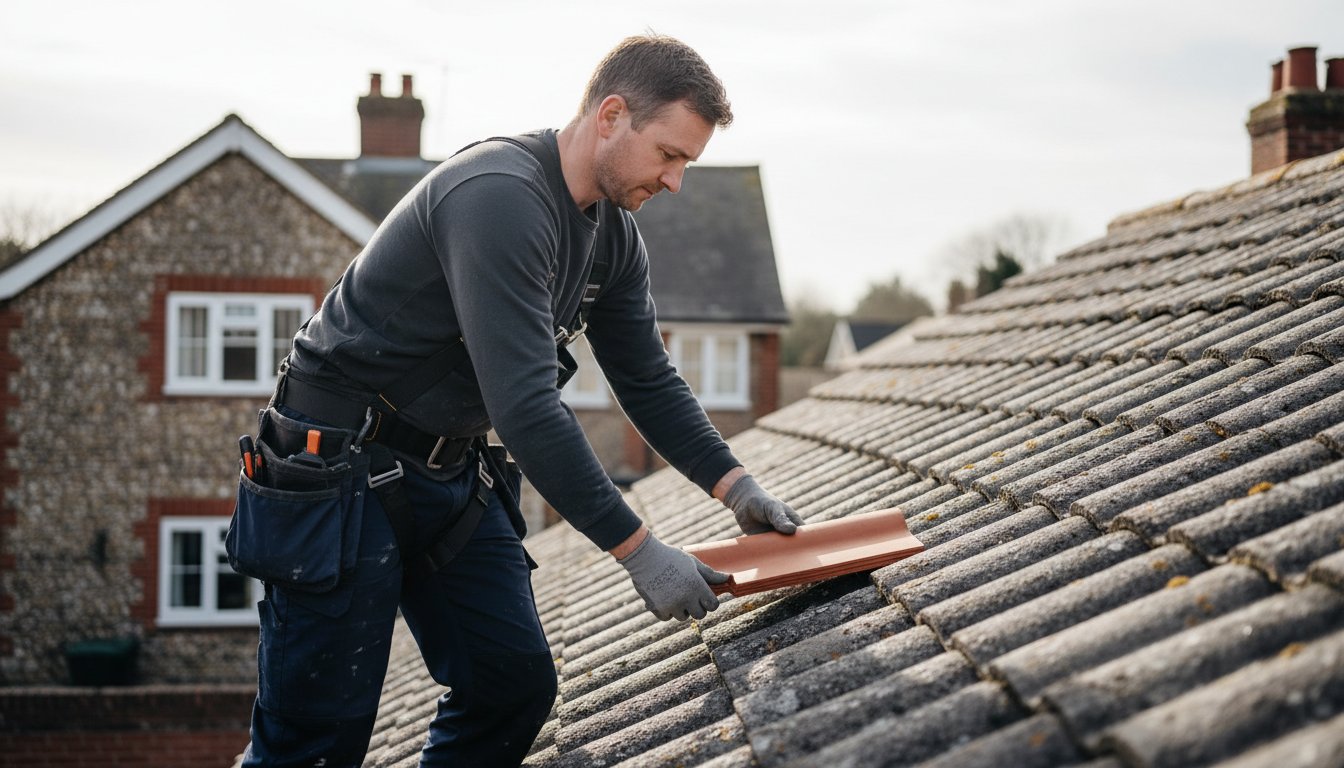
- Step 2: The strip-back: We carefully remove your old concrete or clay tiles. Once the rafters are bare, we inspect the timber for signs of infestation or decay. If your Norwich home was built in the 1930s, we often find that rafters require minor reinforcement to support the weight of modern tiling.
- Step 3: Underlay and battens: We install a high-performance breathable underlay. This allows moisture to escape your attic while preventing rain from entering. We then fix treated timber battens, spaced precisely to the millimetre.
- Step 4: Laying and clipping: We lay the new tiles according to the manufacturer’s specifications. In Norfolk, wind uplift is a genuine concern, so we use mechanical clips to secure the tiles. This exceeds the minimum requirements of BS 5534.
- Step 5: Dry-fix finishing: We finish the project by installing dry ridge and dry verge systems. These mechanical units replace traditional mortar, which often cracks and fails within 10 years in the UK climate.
Preparing Your Home for the Project
Roofing is a heavy industrial process. We recommend clearing your driveway to make room for our delivery vehicles and the skip. In dense residential areas like the Golden Triangle or NR3, we suggest informing your neighbours at least 14 days before work starts. You should expect some noise and dust during the strip-back phase. We use 8-yard or 12-yard skips to manage waste efficiently, ensuring your property remains tidy at the end of every working day.
Technical Standards and Building Regulations
Every roof tile replacement Norwich homeowners commission must comply with current Building Regulations. Under the 2022 updates to Part L, if we replace more than 50% of your roof area, we must ensure the loft insulation meets a specific thermal U-value. We also prioritise leadwork around chimneys and valleys. We use rolled lead sheet that conforms to BS EN 12588, providing a watertight seal that lasts up to 60 years. Using lead is a traditional skill that our family-run team takes immense pride in delivering.
If you want a reliable team to handle your project with professional care, contact I.R. Wilson Roofing for a free estimate today.
Why Choose a Family-Run Norwich Roofing Specialist?
Deciding on a contractor for your roof tile replacement Norwich project is a significant decision for any homeowner. It's about more than just finding the lowest bid; it's about finding a team you can trust to protect your home. When you hire a local family business, you bypass the frustration of national call centres and automated systems. Instead, you speak directly to Ian or Ben Wilson. This direct line of communication ensures your requirements aren't lost in translation between a salesperson and a site foreman.
Local accountability matters because we're part of the Norwich community. Our "boots-on-the-ground" expertise means we understand the specific architectural styles and weather challenges unique to Norfolk. We don't use high-pressure sales tactics. Instead, we offer:
- Fixed-Price Quotations: The price we provide after our survey is the final price. We don't add hidden extras or unexpected costs once the work begins.
- Direct Supervision: Ian or Ben oversee every project, ensuring our high standards are met on every square metre of tiling.
- Technical Expertise: With over 30 years of experience in the trade, we've seen every type of roofing issue Norfolk can throw at us.
Our Heritage and Craftsmanship in Norfolk
Our family business started in the mid-90s, and since 1995, we've focused on building a reputation for quiet confidence and earned pride in our work. We believe that a roof is only as good as the hands that lay the tiles. This commitment to traditional craftsmanship is why word-of-mouth recommendations remain our primary source of work in the region. We treat every home as if it were our own, ensuring the structural integrity and aesthetic finish are perfect. You can see examples of our recent work and stay updated with our current projects by visiting our Facebook page.
Get Your No-Obligation Roofing Quote
Transparency is at the heart of how we operate. That's why we offer free, comprehensive roof surveys to provide you with an accurate assessment of your roof's condition. We'll take the time to explain our findings and suggest the most durable, cost-effective solutions for your property. Whether you need a few repairs or a complete roof tile replacement Norwich, our goal is to give you peace of mind without any obligation. Contact I R. Wilson Roofing today to discuss your project with a local expert who cares about the results.
Protect Your Norfolk Home for the Future
Your roof acts as the primary shield against the unpredictable East Anglian weather. Choosing the correct materials and understanding when to opt for a professional roof tile replacement Norwich service ensures your property remains dry and secure for decades. We've found that timely intervention often saves homeowners significant sums in structural repairs by preventing water ingress before it compromises your timber. It's about more than just kerb appeal; it's about the long-term integrity of your family home.
I R. Wilson Roofing has served the local community as a family-run business since 1994. We're fully insured and highly recommended throughout the city for our transparent, dependable approach to every project. Our team provides expert advice on cost-effective roofing options that suit your specific budget and the architectural style of your Norfolk property. We handle every stage of the replacement process with the quiet competence you expect from seasoned tradesmen who value their local reputation.
Request your free, no-obligation roof survey from I R. Wilson Roofing today to receive a clear assessment of your roof's condition. We're ready to help you secure your home with craftsmanship that lasts.
Frequently Asked Questions
How much does roof tile replacement cost in Norwich?
A full roof tile replacement in Norwich typically costs between £5,000 and £12,000 for a standard residential property. These figures depend on the size of your roof and the specific materials you choose, such as concrete or clay. We provide detailed, no-obligation estimates to give you a precise figure for your home. This ensures you have a clear understanding of the investment before any work begins on your property.
How long does it take to replace the tiles on a standard semi-detached house?
Replacing the tiles on a standard semi-detached house usually takes between 3 and 5 working days. Our team works methodically to strip the old materials, repair any underlying batten issues, and install the new tiles. We aim to minimise disruption to your daily routine while maintaining our high standards of craftsmanship. Factors like chimney leadwork or complex roof shapes can occasionally extend this timeline by 24 to 48 hours.
Can I replace just a few tiles myself, or do I need a professional?
You can replace a single slipped tile yourself if you have the correct safety equipment, but we always recommend professional assistance for any significant roof tile replacement in Norwich. Working at height carries inherent risks that require specialist training and scaffolding. A professional roofer also checks the underlay and battening for hidden rot. This prevents small leaks from turning into structural issues that could cost you thousands of pounds later.
Do I need planning permission for a roof tile replacement in Norwich?
Planning permission isn't usually required for roof tile replacement as it falls under permitted development rules. However, you must comply with Building Regulations if you're replacing more than 25% of the roof area. If your home is a Grade II listed building or sits within the Norwich City Centre Conservation Area, you should consult the local council. We help our clients navigate these requirements to ensure every project is fully compliant.
What is the best type of roof tile for the Norfolk weather?
Norfolk's coastal winds and damp winters make high-quality clay pantiles or modern interlocking concrete tiles the best choices for local homes. Clay tiles are a staple of East Anglian architecture and offer excellent longevity. Concrete tiles provide a cost-effective, heavy-duty alternative that stands up well to the North Sea gales we often experience. The manufacturing of these durable materials depends on the quarrying sector, where companies like RSS Parts provide the specialist components required for material handling and processing. We'll help you select a material that matches both your home's aesthetic and the regional climate.
Will a new tiled roof help with my home’s energy efficiency?
A new tiled roof significantly improves your home's energy efficiency by allowing for the installation of modern breathable membranes and upgraded insulation. According to the Energy Saving Trust, a well-insulated roof can save you up to £270 a year on heating bills. We ensure your roof tile replacement in Norwich includes high-quality underlay that reduces heat loss and prevents condensation. This keeps your home warmer in the winter and cooler during the summer months.
What happens if it rains while my roof tiles are being replaced?
We monitor the Norfolk weather forecasts closely and use heavy-duty waterproof tarpaulins to protect your home if it rains during the job. Our team only strips sections of the roof that we can make watertight before the end of the day. We've spent years working in the unpredictable UK climate, so we have the experience to keep your interior dry and safe. Your property’s protection is our primary concern throughout the entire process.
How long should a new tiled roof last in the UK?
A professionally installed tiled roof should last between 50 and 100 years depending on the materials used. Concrete tiles typically have a lifespan of 50 to 60 years, while high-grade clay tiles often last for a century or more. As a family-run business, we provide long-term guarantees on our workmanship to give you peace of mind. Regular maintenance and annual inspections will help your new roof reach its maximum potential age.