Last October, a homeowner in Thorpe St Andrew discovered that a single slipped tile had led to a £2,400 repair bill because they couldn't find a specialist who understood local Norfolk pantiles. It's a frustratingly common story in our city, where the search for professional roof tiling Norwich often feels like a choice between faceless corporations and contractors who disappear before the job is done. You want a roof that protects your family and preserves your home's market value without the stress of hidden costs.
We agree that every homeowner deserves total transparency and a roofer who treats your property like their own. This guide provides the technical clarity you need to make informed decisions about your home's protection in 2026. You'll discover the practical differences between clay and concrete materials, learn how to distinguish a minor repair from a necessary reroof, and see how our family-run approach ensures your project stays on track. We'll walk you through the entire process from the initial inspection to the final, guaranteed tile.
Key Takeaways
- Compare clay, concrete, and slate to find the best material for your budget and your home's long-term protection.
- Identify the signs that distinguish a simple tile repair from a necessary full replacement to avoid wasting money on temporary fixes.
- Learn how expert roof tiling Norwich solutions can increase your property's value and weather-shielding capabilities in today's competitive Norfolk market.
- Demystify the roofing process by understanding the safety standards and insurance requirements you should expect from any reputable local contractor.
- Discover the benefits of working with a family-run team that prioritizes personal accountability and traditional craftsmanship over high-pressure sales.
Understanding Roof Tiling in Norwich: Aesthetics and Protection
Your roof is the most critical line of defense for your home. In our corner of East Anglia, the roof tiling Norwich residents rely on must handle everything from coastal gales to freezing winter nights. By 2026, the Norfolk housing market has placed a higher premium on kerb appeal, with high-quality roofing contributing significantly to the overall valuation of local properties. A well-maintained roof doesn't just keep you dry; it defines the character of your house.
Modern tiles play a vital role in insulation and energy efficiency, especially for the city's older housing stock. Understanding the history of roof tiles helps us appreciate how materials have evolved from basic clay to high-performance systems. We've seen a shift toward materials that can reduce heat loss through the roof by as much as 25%, making your home cheaper to run and more comfortable to live in.
To see how technical details like head lap affect your roof's performance, watch this helpful demonstration:
The Role of Tiling in Norfolk’s Unique Climate
Norfolk’s weather presents specific challenges. We deal with North Sea winds that carry salt air, which can increase the porosity of certain older tile types over decades. Fluctuating temperatures in East Anglia, often swinging by 15 degrees in a single day, cause tiles to expand and contract. This movement leads to hairline cracks if the materials aren't high-grade. In rural parts of the county, moss growth is a frequent issue. High moisture levels allow moss to thrive, which can lift tiles and allow water to seep into the roof timbers.
Common Tiling Styles Found Across Norwich Neighborhoods
Norwich neighborhoods have distinct personalities reflected in their rooftops. In the city centre, the iconic Norfolk Pantile remains a staple. These S-shaped clay tiles are essential for maintaining the historic character of local heritage sites. In newer developments like Cringleford, we see a preference for modern interlocking concrete tiles. These offer faster installation and better wind resistance for exposed plots. Meanwhile, the Victorian and Edwardian terraces of the Golden Triangle require specific aesthetic matches. Using the correct roof tiling Norwich homeowners expect in these conservation areas is vital for preserving the architectural integrity of these 100-year-old streets.
Our team at I.R. Wilson Roofing understands these local nuances. We've spent years working on these specific roof types, ensuring every job is completed with the quiet confidence of a family-run business that cares about the community. If you're concerned about the state of your tiles, we offer a free, no-obligation estimate to help you plan your next steps.
Comparing Materials: Clay, Concrete, and Slate for Your Norfolk Home
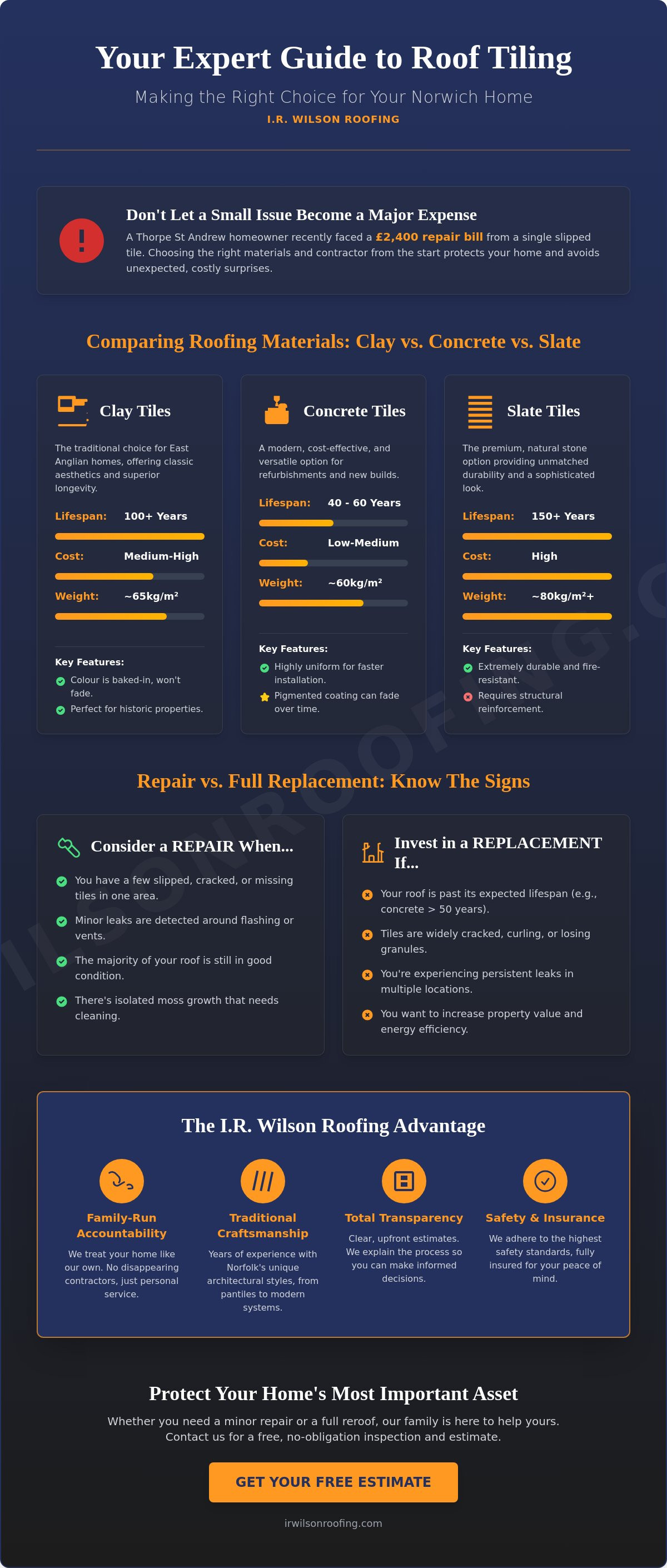
Choosing the right materials for your roof tiling Norwich project involves balancing your immediate budget with your long-term plans for the property. We've seen many homeowners overlook the weight of these materials, which is a critical mistake. A standard clay tile installation can weigh up to 65kg per square metre. If your home was built before 1950, we must inspect the underlying timber structure first. Older rafters often require reinforcement before they can safely support the weight of modern concrete tiles or heavy natural slate. We always prioritize the safety of your home's skeleton before we lay a single tile.
Clay vs. Concrete: The Cost vs. Longevity Debate
Clay tiles are a traditional staple of East Anglian architecture and offer an impressive lifespan of 100 years or more. One of their biggest advantages is colour-fastness. Because the colour is baked into the natural clay, it won't fade or peel over decades of exposure to the elements. Concrete tiles are the more cost-effective choice for modern refurbishments. They typically last between 40 and 60 years and are easier to install due to their uniform size. However, concrete relies on pigmented coatings that can weather over time. Both materials must meet rigorous testing and standards for roof tiles under British Standard BS 5534. This ensures they can withstand the specific wind speeds and rain levels we experience in Norfolk.
The Appeal of Natural and Man-Made Slate in East Anglia
Natural slate remains the premium aesthetic choice for historic Norwich properties. It's incredibly durable, fire-resistant, and requires very little maintenance once it's correctly fixed. For homeowners looking for that classic look on a tighter budget in 2026, fibre-cement slate is an excellent alternative. It's much lighter than natural stone, which makes it a perfect fit for older timber frames that can't handle a heavy load. Fibre-cement options are also pre-drilled, which speeds up the installation process and reduces labour costs. If you're still deciding which material fits your specific house type, you should check our Expert Roofers in Norwich Buying Guide for more tips on selecting the right contractor for the job.
When you're deciding on a material, think about how long you plan to stay in the property. If you're planning for this to be your "forever home," the 100-year durability of clay or natural slate provides the best value. For those looking to refresh a property before a sale, concrete offers a clean, professional finish at a lower price point. We recommend a professional site survey to determine exactly which material your roof structure can support before you make a final commitment.
Roof Tile Repair vs. Full Replacement: Making the Right Investment
"Can I just fix the broken ones?" This is the most common question we hear from homeowners across Norfolk. While a quick patch-up is often possible, you need to consider the long-term cost. If your roof is approaching 80 years old, paying for multiple minor repairs every winter becomes a false economy. These small bills add up quickly. Over a five-year period, constant patching can cost significantly more than the initial investment for a full replacement. In the competitive Norwich property market, a professionally installed roof doesn't just keep you dry. It boosts your home's kerb appeal and resale value, often providing a high return on investment when it comes time to sell.
When to Patch: Identifying Minor Tile Damage
We recommend patching when the damage is isolated. This usually involves slipped tiles after a storm, minor leadwork failure around a chimney, or damage from wind-blown debris. Sourcing matching tiles is vital for older Norwich properties to maintain the aesthetic of the street. We often use reclaimed materials to ensure the new tiles blend perfectly with your existing roof. Spalling is the flaking of tile surfaces due to freeze-thaw cycles. If you see red dust in your gutters, your tiles are likely spalling. For sections of your home with a low pitch, you should refer to our Flat Roof Repairs Norwich Guide for specific advice.
Signs Your Norwich Property Needs a Full Retile
Sometimes a repair isn't enough to protect your home. If you can see daylight through the loft floor or notice persistent dampness on the rafters, the protective barrier has failed. Even if your tiles look okay from the ground, the underlying bitumen felt can suffer from rot after several decades. This makes the felt brittle and prone to leaking during heavy rain. We also frequently encounter "nail sickness" on older properties. This happens when the galvanized nails holding the tiles in place rust away. Once the nails fail, tiles begin to slide off in large numbers. This makes a full retile the only safe and reliable option for your roof tiling Norwich project. We provide a full assessment to help you decide which route is best for your property and your budget, ensuring your home remains a safe, dry environment.
The Professional Tiling Process: What to Expect from Local Contractors
Starting a major home project often brings a mix of excitement and worry. We understand that seeing your home surrounded by scaffolding can be stressful. Our team works to demystify the process by providing clear timelines and maintaining a tidy site from start to finish. For any roof tiling Norwich project, safety is our first priority. We strictly follow Health and Safety Executive (HSE) guidelines and maintain comprehensive public liability insurance to protect your property and our workers. If your home is located on one of the busier streets in the city centre or the narrow terraces of the Golden Triangle, we manage the necessary local council permits for scaffolding and skip placement on your behalf.
A retile is also the most cost-effective time to address other external issues. We often recommend reviewing your Guttering Services in Norwich while the scaffolding is already in place. It's much simpler and more affordable to install new, high-capacity gutters when the bottom row of tiles is being replaced, ensuring your home is fully protected from the Norfolk rain for the long term.
Preparation, Stripping, and Modern Breathable Membranes
We begin by carefully stripping away the old tiles and the original bitumen felt. In 2026, replacing old, brittle felt with a high-performance breathable membrane is a non-negotiable standard for a quality roof. This modern material allows trapped moisture to escape the attic space while remaining completely watertight from the outside, preventing the damp issues common in older Norfolk properties. During this strip-back phase, we inspect every roof timber. We treat the structure for woodworm and replace any sections affected by rot. We then install new, pressure-treated timber battens, ensuring they are perfectly level to provide a secure, straight foundation for your new roof tiling Norwich installation.
Installation Standards: Dry Verge and Ridge Systems
The way we finish the edges and peaks of your roof has evolved significantly. While traditional mortar-bedded ridges were common for decades, they often crack and fail due to the UK's temperature swings and seasonal storms. We now favor 'Dry Fix' systems for ridges and verges. These mechanical fixings use screws and clamps rather than cement, making them virtually maintenance-free and much more resistant to high winds. We pay close attention to the tile overlap, which we calculate precisely based on the pitch of your roof. This ensures that even during heavy wind-driven rain, water cannot penetrate the layers. Our family-run team takes pride in these technical details, ensuring your home remains dry and secure for decades to come.
If you're ready to secure your home with a professional finish, you can request a free, no-obligation estimate from our local experts today.
Choosing I.R. Wilson Roofing for Your Norwich Tiling Project
Since 1994, I.R. Wilson Roofing has operated as a dedicated, family-run business within the Norfolk area. The partnership between Ian and Ben represents more than just a name; it is a commitment to heritage and personal accountability. We have spent over 30 years refining our trade, ensuring that every project reflects the high standards our family name stands for. When you choose us for your roof tiling Norwich project, you aren't just another number on a spreadsheet. You are a neighbor, and we treat your property with the same care we would give our own.
Our Family-Run Approach to Quality Craftsmanship
Our reputation in Norwich is built on word-of-mouth recommendations and a history of reliable service. We specialize in a broad range of roofing disciplines, from traditional clay and concrete tiling to high-performance modern flat roof solutions. Because we are a local team, we understand the specific weather challenges Norfolk homes face. We back our craftsmanship with robust protection to give you total peace of mind:
- 10-year guarantees on standard repairs and specific workmanship.
- 25-year guarantees on full re-roofs and premium materials.
These guarantees act as a digital handshake, promising that we will be here to support you long after the scaffolding comes down. We take pride in our "boots-on-the-ground" mentality, which means the people you speak to during the quote are the same people ensuring the work is completed correctly. To learn more about our specific installation standards and what to look for when hiring a contractor, visit our Roof Replacement Norwich Buying Guide.
Requesting Your Competitive Tiling Quote in Norwich
Finding a reliable price shouldn't be a stressful experience. We offer a transparency-first policy that prioritizes your needs over our profit margins. If your roof only requires a minor repair to extend its lifespan by another decade, that's exactly what we will tell you. We only recommend a full retile when it is truly necessary for the safety and structural integrity of your home.
We encourage all homeowners to book a free site survey. This allows us to perform a physical inspection of your roof tiling Norwich, checking for slipped tiles, perished underlay, or damaged leadwork. Following this assessment, we provide a fixed-price quotation. This means the price we quote is the price you pay, with no hidden extras or unexpected costs halfway through the job. We are here to provide professional, no-obligation advice to help you protect your home effectively.
Securing Your Norfolk Home for the Decades Ahead
Your roof is the first line of defense against the unpredictable Norfolk elements. Choosing the right material, whether it's traditional clay or durable concrete, ensures your property stays dry and retains its market value through 2026 and beyond. Making an informed choice between a targeted repair and a full retile can save you significant costs over the lifespan of your building. We've helped local homeowners navigate these technical decisions since 1994, bringing three decades of family-run expertise to every street in the city.
When you're ready to invest in professional roof tiling Norwich homeowners can depend on, you need a team that prioritizes long-term quality over quick fixes. We provide competitive fixed-price project fees and the reassurance that comes with being a fully insured contractor that's highly recommended throughout the region. Our focus remains on straightforward communication and the kind of honest craftsmanship that protects your family's most valuable asset.
Get a Free, No-Obligation Roof Tiling Quote from I.R. Wilson Roofing today. We look forward to helping you build a safer, more beautiful home for the years to come.
Frequently Asked Questions
How much does roof tiling cost in Norwich for a standard semi-detached home?
For a standard semi-detached home in Norwich, a full retile typically costs between £5,000 and £8,000 based on 2024 industry averages. This price range covers the cost of scaffolding, waste removal, and new concrete tiles. Prices can increase by 20% or more if you choose premium clay tiles or natural slate. We provide a detailed, no-obligation estimate after a physical site visit to ensure your quote is accurate and fixed.
How long does it take to retile a roof on a Norwich terrace house?
Retiling a standard terrace house in Norwich usually takes our team between 5 and 7 working days. This timeline includes stripping the old materials, replacing the underlay and battens, and laying the new tiles. Weather conditions can impact the schedule, but we use protective measures to keep your home dry throughout the process. Our family-run team works methodically to ensure we complete the work to the highest standards without unnecessary delays.
Do I need planning permission to change the type of tiles on my roof in Norwich?
You don't usually need planning permission to change your roof tiles if the new materials are similar in appearance to the original ones. This is covered under Permitted Development rights. However, if your property is a listed building or located in one of Norwich’s 17 conservation areas, you must consult the local council first. We can advise you on suitable materials that meet local building regulations and preserve the character of your neighborhood.
What is the best type of roof tile for a house in a Norfolk conservation area?
Traditional clay pantiles are often the best choice for homes in Norfolk conservation areas. These tiles have defined the local skyline since the 17th century and are frequently requested by planning officers to maintain architectural heritage. Natural slate is another excellent option for Victorian or Edwardian properties in the city. We source high-quality, authentic materials that satisfy conservation requirements while providing modern durability and a long-term guarantee.
Can I install solar panels on my new roof tiles immediately after installation?
Yes, you can install solar panels as soon as your roof tiling Norwich project is complete. It's often more efficient to plan these projects together so the solar installers can utilize the existing scaffolding. We ensure the new tiles are correctly positioned and the roof structure is reinforced to handle the additional weight of the panels. This coordinated approach protects your new roof and ensures the installation doesn't void your workmanship guarantee.
How often should I have my roof tiles inspected for damage in Norwich?
You should have your roof tiles professionally inspected at least once every 2 years to identify minor issues before they become leaks. It's also a good idea to perform a visual check from the ground after heavy storms, which are common in East Anglia. Regular maintenance can extend the life of your roof by decades. Our reliable team provides thorough inspections to check for cracked tiles, blocked guttering, or failing leadwork, giving you total peace of mind.
Is it possible to tile over an existing roof to save money?
We don't recommend "roof-over" installations because the combined weight of two tile layers can cause the roof structure to sag or collapse. UK building regulations typically require you to remove the old tiles to inspect the rafters and install modern, breathable underlay. Stripping the roof is the only way to guarantee a watertight finish and a long lifespan. Our family-run business prioritizes the safety of your home by following best industry practices every time.
What should be included in a professional roofing quote in Norwich?
A professional quote should include a full breakdown of costs for labor, materials, scaffolding, and the disposal of old roofing waste. It should also clearly state the type of tiles being used and the length of the workmanship guarantee. We provide transparent, written quotes that leave no room for hidden extras. This clear communication ensures you know exactly what to expect from our team before any work begins on your property.