Choosing the cheapest roofing material today might be the most expensive mistake you make for your home's long term health. We understand that reviewing a quote for a full replacement is a significant moment, especially when you're trying to weigh up the slate vs tile roof cost UK homeowners are facing in 2026. It's natural to feel torn between the lower upfront price of concrete and the rugged, timeless reliability of natural slate. You need a roof that stands up to the British weather without worrying if your home's rafters can handle the weight or if you're overspending on materials.
Our team has put this guide together to give you total clarity on which material offers the best return for your property and your peace of mind. You'll learn how different options like Spanish slate or clay tiles stack up regarding lifespan, craftsmanship, and ongoing maintenance. We also explain how the 2026 Future Homes Standard impacts your insulation requirements and your total project budget. This comparison provides the facts you need to make an investment that keeps your home dry and secure for 50 years or more.
Key Takeaways
- Understand the core differences between natural quarried stone and man-made clay or concrete alternatives to ensure your choice matches your home's character.
- Review the current slate vs tile roof cost UK pricing for 2026, including a clear look at how labour and material quality influence your total project quote.
- Evaluate the lifespan gap between materials to see why an investment in slate can protect your home for a century compared to the 50-year cycle of standard tiles.
- Learn how the 2026 Future Homes Standard and structural weight requirements affect your choice between lightweight tiles and traditional heavy slate.
- Discover the resale potential of reclaimed materials, allowing you to treat your roof as a long-term asset rather than just a maintenance expense.
Understanding the Basics: Slate vs Tile Roofing in the UK
Selecting a new roof is one of the most significant decisions you'll make for your property. In the UK, the debate usually comes down to two main contenders: natural slate and man-made tiles. We see this choice dominating the market in 2026 because both materials offer proven protection against our unpredictable climate, yet they provide very different results for your home's appearance and long-term value. Understanding the technical differences is the first step in weighing up the slate vs tile roof cost UK homeowners must consider before committing to a project.
Natural slate is a metamorphic rock harvested directly from the earth. To understand the geology behind it, you can read more about What is Slate? and how it is formed. In the roofing trade, we value it for its natural ability to be split into thin, durable sheets that don't absorb water. Conversely, roof tiles are manufactured products. These are typically shaped from clay and fired in a kiln or cast from a mixture of cement, sand, and pigment. Both options have their place, but the right choice depends on your building's structure and your long-term goals for the property.
The Aesthetic Appeal of Natural Slate
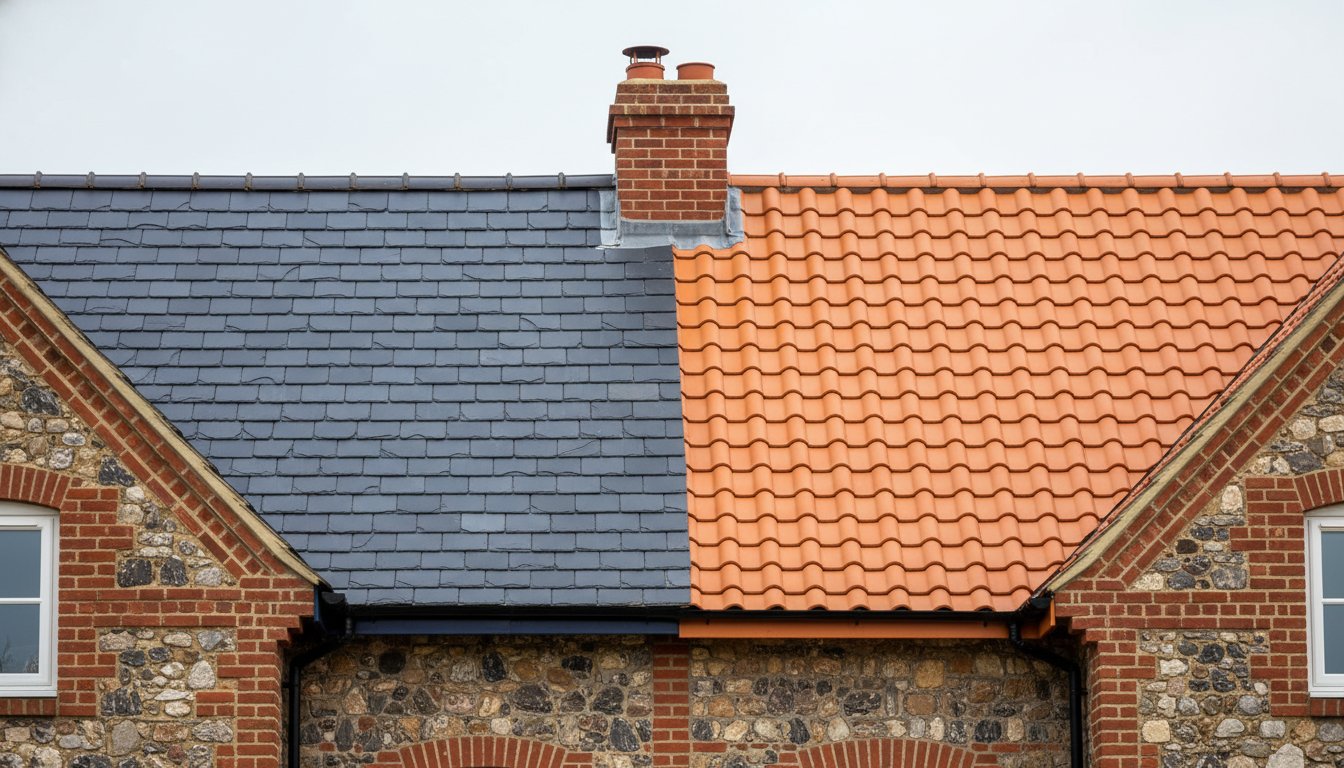
There's a quiet dignity in a slate roof that man-made materials struggle to replicate. Whether it's the deep blue-grey of Welsh slate or the slightly more textured finish of Spanish and Brazilian varieties, the look is timeless. For many of our clients in Norwich and across Norfolk, this isn't just about personal taste. Local conservation areas often mandate natural slate to preserve the historical character of the neighbourhood. You can choose between a rugged, hand-split edge for a traditional look or a more uniform, machine-cut finish for a cleaner aesthetic.
The Versatility of Clay and Concrete Tiles
If you're looking for variety, modern tiles offer an impressive range of colours and profiles. Clay tiles provide a warm, traditional feel that matures beautifully over time, often turning a deep orange or red. Concrete tiles have become the standard for much of the UK's 20th-century housing because they're reliable and highly functional. We often find that modern interlocking tiles are a practical solution for budget-conscious projects. They can mimic the appearance of slate while being much faster to install. This versatility is a key factor when calculating the slate vs tile roof cost UK for a modern build or a standard renovation.
The Price Gap: Slate vs Tile Roof Cost Comparison (2026 Estimates)
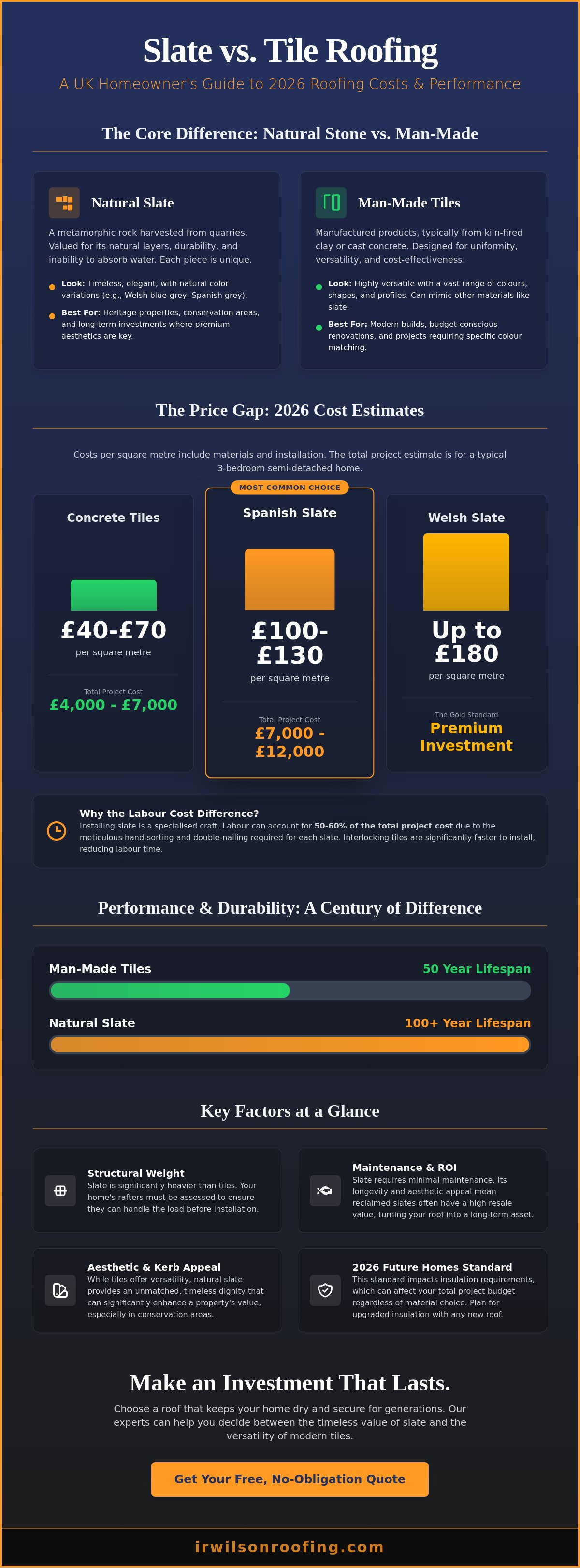
When you start looking at quotes, the price difference between materials is usually the first thing that jumps out. For a typical 3-bedroom semi-detached home, a professional tile replacement using standard concrete might range from £4,000 to £7,000. If you choose Spanish slate, that same project often moves into the £7,000 to £12,000 bracket. This gap is real. You aren't just paying for the stone; you're paying for the specialized skill. Labour typically accounts for 50% to 60% of the total cost of a slate installation. Understanding the slate vs tile roof cost UK involves looking at both the upfront material purchase and the long-term labour investment required for a secure finish.
Your roof's pitch and complexity also dictate the final figure. A steep roof with multiple valleys, dormers, or chimneys requires more leadwork and careful manual cutting. These architectural features add hours to the project, which is why a simple "per square metre" estimate is usually just a starting point. We find that complex roofs often see a higher price jump when choosing slate because the material requires more precise handling than standard tiles.
Material Costs: Natural Stone vs Factory-Produced Tiles
Spanish slate is the most common choice in 2026, typically sitting between £100 and £130 per square metre installed. Premium Welsh slate remains the gold standard but can reach £180 per square metre. Concrete tiles are the most budget-friendly option, with installed costs often between £40 and £70 per square metre. We always recommend checking current availability, as 2026 supply chain shifts can impact lead times for specific stone grades.
Labour and Installation Complexity
Slating is a meticulous process. We have to hand-sort every stone and double-nail each piece to the battens. This creates a roof that withstands coastal gales but takes much longer than laying interlocking tiles. Interlocking tiles "click" into place. This speeds up the job and reduces the total slate vs tile roof cost UK by cutting scaffold hire time. Hiring professional roofers in Norwich ensures your installation meets all 2026 building regulations and safety standards.
If you're still weighing up these options, you might find our detailed roofing cost breakdowns helpful for your planning.
Performance and Durability: Beyond the Initial Price Tag
While comparing the slate vs tile roof cost UK homeowners see in their quotes, it's vital to look past the first decade of ownership. Durability is where the real value reveals itself. A natural slate roof is famously long-lived, often reaching 75 to 100 years of service. Quality tiles, while reliable, typically face a 50-year lifespan before they require major work. This longevity makes slate a generational investment. You aren't just buying a roof; you're securing your property for the next century.
Both materials are non-combustible, which provides essential fire safety for your family. Regarding thermal performance, the dense nature of stone helps regulate temperatures by absorbing heat slowly. However, modern building standards focus heavily on the insulation layer beneath the surface. We ensure every project meets the 2026 U-value requirements of 0.11 W/m²K for pitched roofs. This means your home stays warm and energy-efficient whether you choose traditional slate or modern interlocking tiles.
Weight Considerations and Structural Integrity
Natural slate carries significant weight compared to modern concrete tiles. This mass provides excellent stability during high winds, but it places a heavy load on your building's skeleton. Checking your roof timbers is a non-negotiable step before we begin work. If you're switching from a lighter material to a heavy Welsh slate, your rafters might need extra support. For many older Norfolk cottages, timber replacement or structural reinforcement is a necessary part of the project to prevent the roof from sagging over time.
Resilience in the Norfolk Climate
Our local climate presents unique challenges that impact the slate vs tile roof cost UK over time. High-quality natural slate is exceptionally resistant to the salty coastal air found across Norfolk. It doesn't suffer from delamination, where layers of stone peel away, provided you avoid low-grade imports. Tiles, particularly concrete ones, are more porous. This makes them a magnet for moss and lichen growth in our damp environment. While moss might look charming, it can block your gutters and trap moisture against the tile, which eventually leads to frost damage and cracks during a cold winter.
Maintenance and Reusability: The Hidden ROI of Slate
When we sit down with homeowners to discuss a quote, we often talk about the 'exit value' of their roofing material. Most people don't realize that a natural slate roof acts much like a long-term asset for your property. While the initial slate vs tile roof cost UK seems high, the reclaimed slate market in East Anglia is thriving. If a slate roof reaches the end of its life after a century, the individual stones can often be salvaged, cleaned, and resold for use on heritage projects. This resale value simply doesn't exist for concrete tiles, which are usually crushed for road aggregate once they're removed.
Clay tiles occupy a middle ground. High-quality clay can often be reclaimed, but concrete remains a one-time use product. From a purely financial perspective, being able to sell your old roof can significantly offset the cost of its eventual replacement. This hidden return on investment is a major reason why slate remains a favourite for those planning to keep their home in the family for generations. You're essentially paying for a material that holds its value better than almost any other part of your home's exterior.
Repairing vs Replacing: A 20-Year Outlook
Maintenance needs change as your roof ages. In older slate roofs, we often see a phenomenon called 'nail sickness.' This isn't a failure of the stone itself, but the corrosion of the iron or steel nails used decades ago. By carrying out targeted roof repairs in Norwich, we can often pull up the slates, replace the fixings, and relay the original stone. This process can extend the life of a roof by another 30 or 40 years without the cost of new materials. In contrast, concrete tiles tend to become brittle after 40 years of UV exposure. When they reach this stage, they often crack underfoot during simple repairs, making a full re-roof the only dependable solution.
Sustainability and Carbon Footprint
If you're concerned about your home's environmental impact, natural slate is the clear winner. It has incredibly low embodied energy because it's simply quarried and split by hand. There are no high-temperature kilns involved like those used for clay tiles, and no chemical-heavy cement processes required for concrete. Because you only have to buy one slate roof for every two tile roofs over a 100-year period, the carbon footprint of your home is drastically reduced. It's the most sustainable way to protect your property while managing the long-term slate vs tile roof cost UK effectively.
If you're worried about a specific leak or a slipped stone, you can explore our roofing maintenance guides to see how we handle these common issues.
Making the Final Decision for Your UK Property
Deciding on a roof replacement involves more than just looking at the bottom line of a quote. You have to consider your long-term plans for the property. If you intend to stay in your home for the next 20 or 30 years, the higher slate vs tile roof cost UK homeowners pay upfront becomes a wise investment. Natural slate provides a premium finish that boosts curb appeal and increases the eventual resale value of your home. However, if you are working with a strict budget or a modern property designed for lighter materials, concrete or clay tiles are the logical, dependable choice. They offer a clean look and reliable protection without the need for structural reinforcement.
For some, the best path is a middle ground. High-quality slate-effect tiles or fibre cement options can mimic the texture of natural stone while keeping the weight and cost closer to standard tiling. Whatever material you select, the most important factor is securing a fixed-price quotation. This protects you from the "hidden extras" that can sometimes arise during a project. We always provide a clear, detailed breakdown so you know exactly where your investment is going.
Consulting Local Planning and Conservation Rules
In our part of the world, your choice might already be made for you by local authorities. If your home is in the Norwich city centre or within the sensitive areas of the Norfolk Broads, conservation rules often dictate the specific materials you must use. Listed buildings almost always require a like-for-like replacement with natural stone to preserve the historical fabric of the area. We always recommend checking your property's status with the local council before ordering any materials. A roofer who understands these local Norfolk planning nuances can save you from a costly legal headache with the planning office later.
Why a Family-Run Professional Makes the Difference
We believe that who installs your roof is just as important as the material itself. I. R. Wilson has been a family-run business since 1994, and that heritage means we take a personal interest in every project we undertake. We don't just send a faceless crew; we provide owner-led oversight to ensure the leadwork is precise and every slate is nailed correctly. This level of hands-on accountability is what distinguishes a roof that lasts for decades from one that needs constant attention after the first winter gale. Our reputation is built on the safety and satisfaction of our neighbours across the community.
Ready to upgrade your roof? Get a professional, fixed-price quotation from I. R. Wilson Roofing today.
Securing Your Home’s Future with the Right Choice
Choosing between natural stone and man-made tiles is a decision that impacts your home for decades. We've seen how the slate vs tile roof cost UK homeowners face in 2026 is influenced by material longevity, specialized labour, and local planning requirements. Whether you opt for the century-long protection of Spanish slate or the practical versatility of modern concrete tiles, the goal is a secure and energy-efficient home. Your property deserves a roof that stands up to the Norfolk elements while meeting the latest building standards.
As a family-run business serving Norwich since 1994, we take pride in our quiet confidence and earned reputation. We specialize in both traditional slate and modern tiling, ensuring every project benefits from our hands-on craftsmanship. We provide competitive, fixed-price quotations with no hidden extras, so you can plan your investment with total peace of mind. We are here to help you navigate these choices and deliver a result that protects your family for years to come.
Get an Expert Roofing Quote for Your Norwich Home and let's discuss the best solution for your property today.
Frequently Asked Questions
Is slate more expensive than tile in the UK?
Yes, natural slate is generally more expensive than both concrete and clay tiles. This price difference stems from the higher cost of quarried stone and the specialized, time-intensive labour required for a secure installation. While the upfront investment is greater, the 100-year lifespan of slate often makes it the more economical choice for those looking at a century of property ownership.
How much does a new slate roof cost for a 3-bed semi-detached house?
For a standard 3-bedroom semi-detached property in 2026, a Spanish slate roof typically costs between £7,000 and £12,000. This estimate includes materials, labour, and necessary scaffolding. If you choose premium Welsh slate, the total will increase due to the higher market value of the stone, though it offers the best durability available in the UK market.
Can I replace my tile roof with slate without reinforcing the structure?
It depends entirely on the current strength of your roof timbers and the specific slate you select. Because natural slate is much heavier than modern concrete tiles, structural reinforcement is often required to prevent sagging. This work usually costs between £1,000 and £3,000. We always perform a detailed survey of your rafters to ensure your home can safely support the additional weight.
How long do concrete roof tiles last compared to natural slate?
Concrete tiles typically provide a reliable service life of 30 to 50 years. In contrast, high-quality natural slate can easily last between 75 and 100 years or more. While concrete is a dependable and functional choice for many homeowners, slate is a generational material that doesn't become brittle or lose its integrity as it ages.
Which roofing material is better for wind and rain in Norfolk?
Natural slate is exceptionally well-suited to the wind-blown rain and salty coastal air we experience in Norfolk. Its dense, non-porous surface prevents water absorption and frost damage during harsh winters. While quality interlocking tiles are also very effective, the weight and double-nailing method used for slate provide unmatched stability during severe coastal gales.
Are slate-effect tiles a good alternative to natural slate?
Slate-effect tiles, such as those made from fibre cement or composite materials, are a practical alternative for those who want the aesthetic of stone without the full slate vs tile roof cost UK. They are lighter and faster to install, which often avoids the need for structural timber work. However, you should remember that these man-made alternatives won't match the 100-year longevity of genuine stone.
Does a slate roof add more value to a house than a tile roof?
Yes, a natural slate roof generally adds more curb appeal and market value to a property than standard tiling. Surveyors and potential buyers often view slate as a premium feature, particularly on heritage or period homes. The fact that the roof may not need replacing for another century is a powerful selling point that can justify a higher asking price.
What is the cheapest roofing material for a pitched roof in the UK?
Concrete tiles remain the most budget-friendly option for pitched roofs across the UK today. They offer a solid balance of durability and low cost, making them the standard choice for modern housing developments and cost-sensitive renovations. While they don't have the heritage feel of slate or clay, they provide a dependable and functional roof for approximately 40 to 50 years.


