Discover the professional roofing standards and local best practices that I R. Wilson Roofing employs to protect homes across Norwich and Norfolk. We believe that quality workmanship isn't just a promise—it's a measurable standard that ensures your property remains safe, dry, and secure for years to come.
Why Local Roofing Standards Matter in the Norwich Climate
In Norfolk, a roof faces more than just rain. The local climate, influenced by the North Sea, presents unique challenges that demand specific, localised best practices. Generic solutions often fail when tested by our region's high winds, salt-laden air, and fluctuating temperatures.
As a family-run team with over 30 years of experience in Norwich, we build roofs designed specifically for these conditions. Our approach is built on a deep understanding of how local weather impacts traditional and modern properties, prioritising long-term durability over quick, temporary fixes.
Norfolk’s Environmental Impact on Residential Roofs
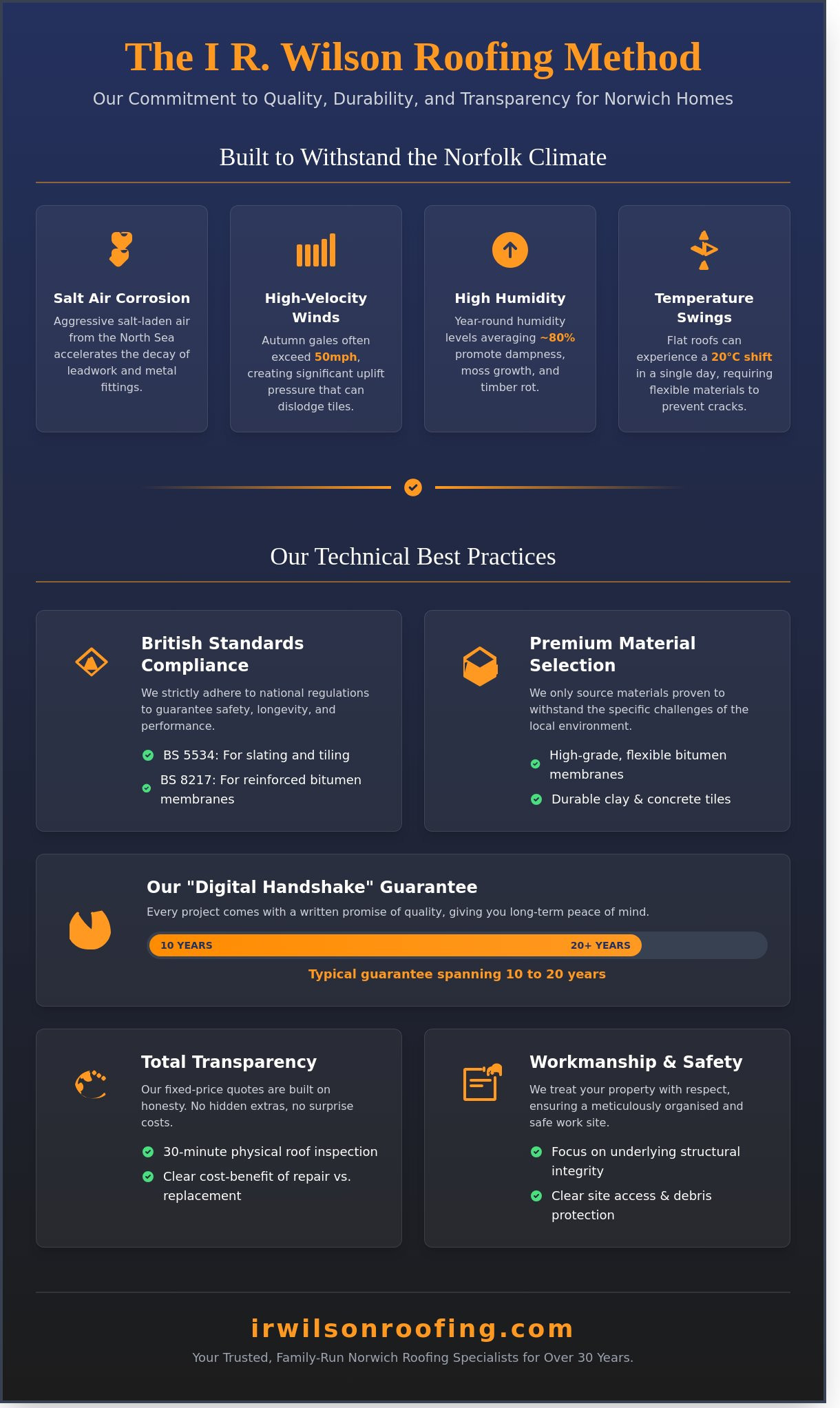
The coastal environment directly affects your roof's lifespan. Salt in the air can accelerate the corrosion of metal components like leadwork and guttering, while high-velocity winds are notorious for dislodging tiles on pitched roofs. Furthermore, the temperature shifts common in East Anglia require flexible materials, especially for flat roofs, to prevent cracking and premature failure.
The Value of a Local Family-Run Perspective
Choosing a local roofer means choosing accountability. Ian and Ben Wilson’s long history in the area informs every decision, from selecting the right materials to withstand a Norfolk winter to understanding the specific needs of local architecture. Unlike national firms, our reputation is built on local word-of-mouth, which remains the ultimate benchmark for quality. That's why so many Norwich homeowners trust our family-run team.
The Technical Best Practices of I R. Wilson Roofing
Our commitment to quality is defined by a strict set of technical standards that govern every project. We combine time-honoured craftsmanship with modern best practices to deliver reliable and lasting results.
- British Standards Compliance: We strictly adhere to all relevant British Standards for slating, tiling, and bitumen felting, ensuring our work meets the highest industry benchmarks.
- Site Safety: Your property's safety is paramount. We maintain a clean, organised, and secure work site from start to finish.
- Quality Materials: We source high-grade, durable materials proven to perform in the Norfolk climate, from robust roof tiles to premium bitumen felt.
- Workmanship Guarantee: We stand behind our work with long-term guarantees, giving you complete peace of mind in your investment.
Fixed-Price Quotations and Transparency
We believe in clear and honest communication. Our process begins with a thorough inspection to provide a detailed, fixed-price quotation with no hidden extras. We’ll explain our findings and discuss the cost-benefit of different options, whether it's a simple repair or a full replacement, so you can make an informed decision.
Workmanship and Quality Control
A strong roof starts with a solid foundation. Our best practices include replacing any rotten or unsound timber before new materials are laid. For flat roofs, we ensure every join is perfectly sealed to eliminate weak points where leaks could develop. Before we consider a job complete, we conduct a final inspection to guarantee every detail meets our exacting standards.
Comparing Flat and Pitched Roof Best Practices
While the goal is always a watertight and durable roof, the best practices for flat and pitched structures differ significantly. We are specialist roofers in Norwich with expertise in both.
Bitumen Felt and Flat Roof Excellence
Bitumen felt remains an excellent choice for garages and extensions in Norwich due to its durability and cost-effectiveness. Our best practice involves a three-layer "pour and roll" system, which creates a robust, multi-layered waterproof barrier. Critically, we ensure the roof has a correct "fall" (a slight slope) to prevent ponding water—the most common cause of flat roof failure. If you're concerned about your current installation, it's worth knowing the signs that you need a new flat roof.
Leadwork and Tiling for Traditional Homes
For pitched roofs, precision is key. Best practices focus on two critical areas:
- Lead Flashing: We expertly install lead flashing at intersections (e.g., around chimneys and in valleys) to create a permanent, waterproof seal at the roof's most vulnerable points.
- Tile & Slate Work: We ensure tiles are laid with the correct overlap and securely fixed to withstand high winds. We can source materials like clay, concrete, or slate to match your home’s character, while also ensuring the roof void has proper ventilation to prevent condensation and damp.
Maintenance Best Practices for Norwich Homeowners
Proper maintenance is the most effective way to extend the life of your roof and prevent costly repairs. Here are a few key practices we recommend for all Norwich homeowners.
- Regular Gutter Cleaning: Blocked gutters are a primary cause of damp in Norwich homes. Ensure they are cleared of leaves and debris at least once a year to allow water to drain freely.
- Inspect After Storms: After a strong Norfolk gale, visually check for any slipped, cracked, or missing tiles from the ground.
- Address Moss Growth: A heavy buildup of moss can hold moisture against your tiles and block drainage channels. Professional removal is safer and more effective than aggressive DIY scraping, which can damage the roof surface.
- Act on Minor Leaks: Don't ignore a small drip. It is often a warning sign of a bigger problem. Calling an expert early can prevent significant structural damage.
Choosing I R. Wilson Roofing for Your Norwich Project
When you choose I R. Wilson Roofing, you are choosing a local, family-run business committed to protecting your home. From the initial enquiry to the final sign-off, we provide clear communication, expert advice, and workmanship you can trust.
Our Norwich-based team is ready to handle everything from emergency storm damage to planned roof replacements. With our fully insured services and fixed-price quotations, you get the professional results you need and the peace of mind you deserve.
Contact Us for a Competitive Quotation
Ready to discuss your project? Contact Ian and Ben today for a free, no-obligation roof assessment. We proudly serve homeowners in Trowse, Norwich, and across the wider Norfolk area.
Request your free roofing quote today
Frequently Asked Questions
What are the common roofing problems in Norwich homes? Common issues include tile damage from high winds, leaks around chimneys due to failed flashing, blocked gutters causing damp, and ponding water on old or poorly installed flat roofs.
How much does a flat roof repair cost in Norfolk? Costs vary depending on the size of the repair and the materials used. We provide a detailed, fixed-price quotation after a free inspection to ensure there are no surprises.
Is I R. Wilson Roofing fully insured for residential work? Yes, we are fully insured for all residential roofing work, giving our clients complete peace of mind.
Do you provide emergency roof repairs in the Norwich area? Yes, we offer responsive emergency repair services to address urgent issues like storm damage and sudden leaks to protect your property.
What is the best material for a flat roof in a windy climate like Norfolk? A high-performance, multi-layer bitumen felt system is an excellent choice. When installed correctly, it is extremely durable, weather-resistant, and can withstand the challenging local climate.
How long does a bitumen felt roof typically last if installed correctly? A professionally installed three-layer bitumen felt roof can be expected to last for 15 to 20 years, and often longer with proper maintenance.
Can you help with leadwork repairs on older Norwich properties? Absolutely. We specialise in traditional leadwork for heritage and older properties, ensuring repairs and replacements are both effective and sympathetic to the building's character.
Why is gutter cleaning considered a roofing best practice? Blocked gutters cause rainwater to overflow, which can saturate walls, damage foundations, and lead to damp and rot in the roof's timber structure. Regular cleaning is essential preventative maintenance.