What if that small damp patch on your ceiling isn't just a minor leak, but a sign that your roof's structural integrity is already failing? In our damp Norfolk climate, what looks like simple wear is often active damage that leads to timber rot if left for even a few weeks. We understand the anxiety that comes with spotting a new stain on the plasterwork. You're likely worried about the £456 to £478 average cost for a full replacement in Norwich, or perhaps you're confused by whether your EPDM or bitumen roof can actually be saved.
This guide will show you exactly how to spot the early signs of flat roof damage before it becomes a structural emergency, potentially saving you from the £530 average repair bill seen across the UK. We've put together a clear checklist to help you identify specific issues like "ponding" or membrane cracks. You'll also learn how the 2026 Future Homes Standard affects your property, including the new 0.18 W/m²K U-value target for retrofits, so you can make an informed, confident decision for your family home.
Key Takeaways
- Learn why East Anglian weather and sea air accelerate the degradation of felt roofs on Victorian extensions and modern garages.
- Master the "48-hour rule" for ponding water and learn to identify the cracking patterns known as alligatoring as early signs of flat roof damage.
- Discover how to differentiate between harmless old "tide marks" and active leaks that indicate immediate structural risk to your home.
- Follow our safe, ground-up inspection method using simple household tools to assess your roof without ever having to step onto a ladder.
- Understand the cost-effective choice between a localized patch repair and a full high-performance bitumen replacement to keep your home warm and dry.
Why Norwich Homes Are Prone to Flat Roof Damage
Norwich homes have a lot of character, but their flat roofs face a tough battle against the elements. From Victorian terraces in the Golden Triangle to modern extensions in Sprowston, these structures deal with a harsh East Anglian environment. We've seen how the North Sea air and heavy rainfall accelerate the decay of Flat roof design and materials. At I R. Wilson Roofing, we know that what starts as a small crack can quickly turn into a structural failure if you overlook the early signs of flat roof damage. Getting these facts right is the priority for any homeowner wanting to avoid the £530 average UK repair bill.
To better understand how these defects begin to form, watch this helpful video:
The Norfolk Climate Factor
Our local weather is the primary driver of roof failure in Norfolk. High winds from the coast don't just blow hats off; they create significant uplift that can peel back poorly bonded felt edges. We also deal with alligatoring, where the sun's UV rays bake the bitumen until it cracks like a reptile's skin. In our humid air, moss growth becomes more than an eyesore. Moss acts like a sponge, holding water against the roof surface and preventing it from draining. This constant moisture accelerates the breakdown of the protective mineral layer on traditional felt. Recognising the signs of flat roof damage early is essential because moisture moves quickly through timber joists.
Typical Flat Roof Lifespans in 2026
While modern high-performance bitumen membranes are designed for longevity, many older Norwich homes still rely on traditional felt installed decades ago. The quality of the original installation plays a massive role in how long these materials last. A roof that wasn't correctly laid or lacks proper insulation can fail long before its expected lifespan. With the 2026 Future Homes Standard now requiring a U-value of 0.15 W/m²K for new installations, many older roofs simply can't keep the heat in. This leads to the 20% heat loss typically seen in uninsulated properties.
Any traditional felt roof in Norwich that has passed the 15-year mark enters a critical danger zone where the risk of sudden water ingress increases significantly. At I R. Wilson Roofing, we prioritize honest assessments so you know exactly if a simple patch repair will suffice or if it's time to upgrade your insulation and membrane to meet modern standards. We take our time to do things correctly the first time because we value our reputation in the local community.
External Signs of Flat Roof Damage You Can See
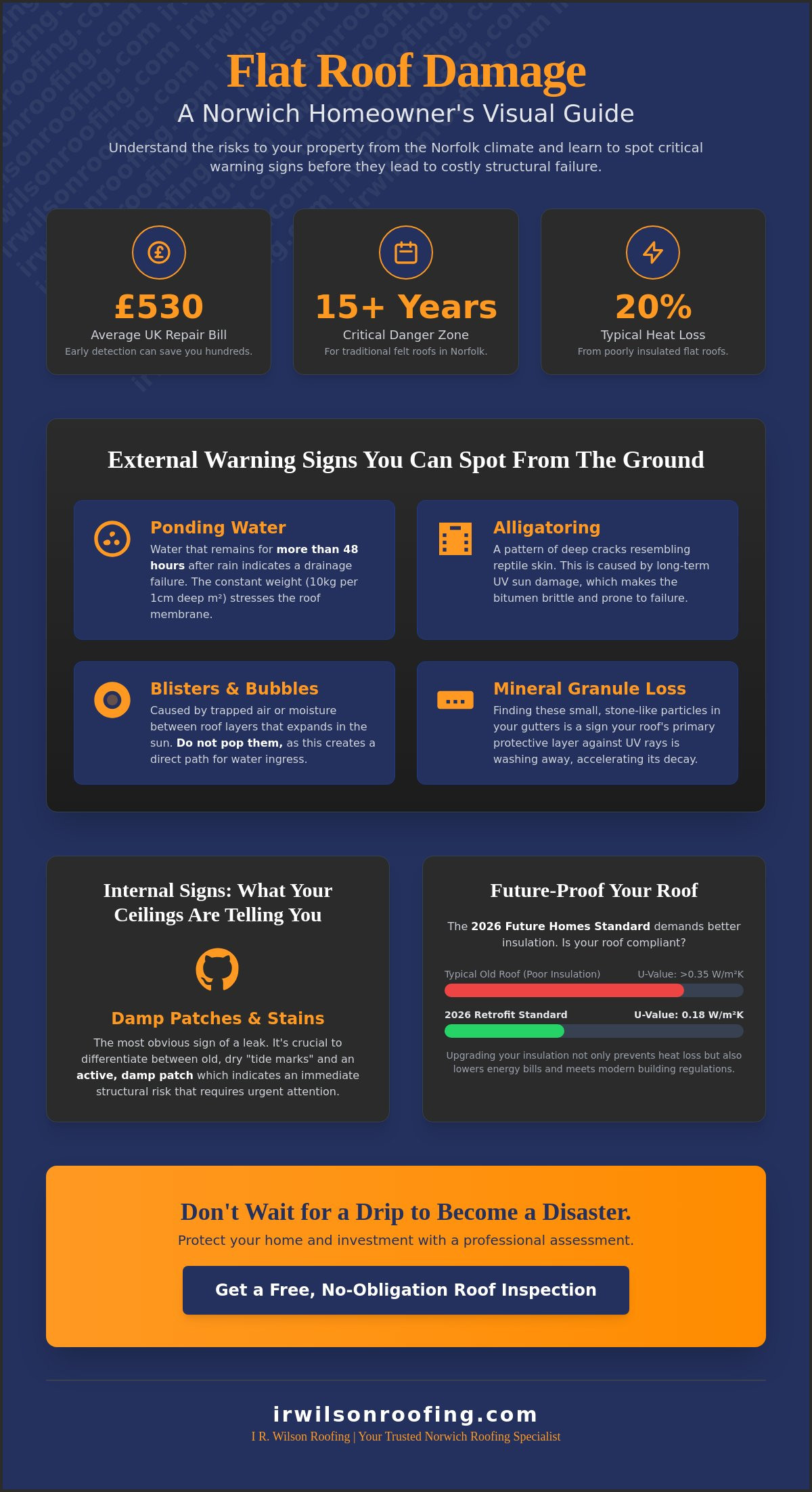
You don't always need a ladder to spot trouble. Often, a quick look from an upstairs window or the garden path reveals the first signs of flat roof damage. One of the most misunderstood issues is ponding water. While a shallow puddle after a heavy Norfolk downpour is normal, it should disappear within 48 hours. If water remains on your roof longer than this, it's a sign that your drainage is blocked or the roof's "fall" has subsided. Standing water is heavy; a single square metre of water just 1cm deep weighs 10kg. This constant pressure can eventually force moisture through the smallest imperfections in the membrane.
Surface Material Degradation
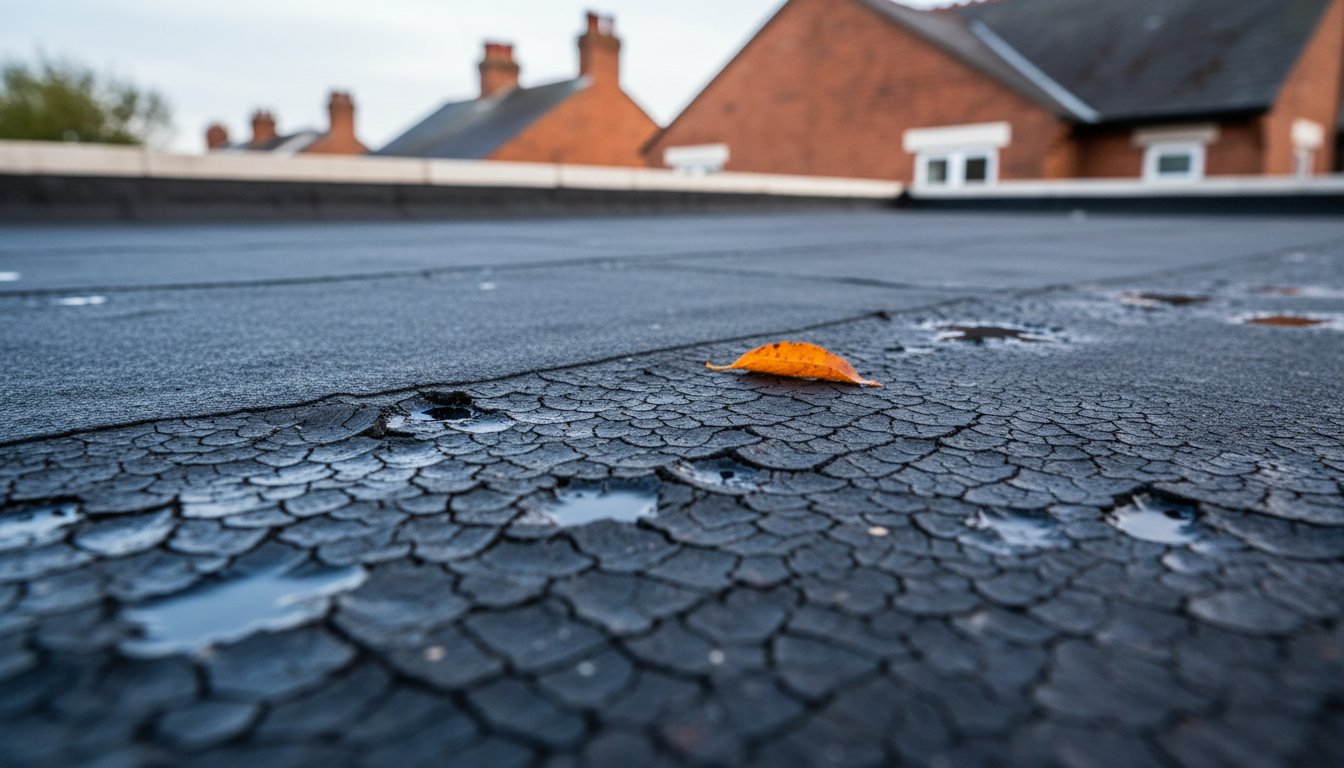
Bitumen roofs often suffer from "alligatoring." This is a pattern of small, deep cracks that look like reptile skin, caused by years of UV exposure. You might also notice a buildup of mineral granules in your guttering. These small stones are designed to protect the underlying felt from the sun. When they wash away, the roof loses its primary line of defence. For a deeper look at how environmental stress impacts these systems, the IIBEC report on Evaluating storm damage to flat-roof assemblies highlights how these surface changes often precede total failure.
Blisters or bubbles are another red flag. These occur when moisture or air gets trapped between the layers of the roof. As the sun warms the roof, the air expands and stretches the material. Don't be tempted to pop them; this will only create a direct path for water to enter your home. Similarly, look for punctures caused by fallen debris or even bird activity, as gulls are known to peck at soft roofing materials in coastal areas like ours.
Structural Movement and Sagging
If you notice your roofline looks uneven or has a visible dip, the problem is likely structural. Sagging is a serious indicator that the timber deck or joists have softened due to long-term water ingress. This often happens at the edges where the roof meets the fascias and soffits. If these perimeter boards are rotting or pulling away, they can no longer support the roof's edge properly. This leads to gaps where rain can be driven directly into your wall cavity by the wind.
We've seen many cases where catching these external issues early prevented a full ceiling collapse. If you've spotted a dip or a persistent puddle, we're always happy to provide a free, no-obligation estimate to give you peace of mind and protect your home's value.
Internal Warning Signs: What Your Ceilings Are Telling You
When the external membrane of your roof fails, the evidence eventually finds its way inside. For many Norwich homeowners, the first hint of trouble isn't a drip, but a change in the appearance of a ceiling or wall. You might notice a light brown "tide mark" or a patch of discoloration in the corner of a kitchen extension. It's vital to differentiate between old, dry stains and active leaks. If a patch feels damp to the touch or grows larger after a typical Norfolk rainstorm, the seal on your roof is likely compromised. These internal signs of flat roof damage are your home's way of telling you that water is bypassing your insulation and reaching the plasterboard.
Don't ignore the "nose test" either. A persistent musty or earthy odor in a room with a flat roof is a major red flag. This smell often indicates that moisture is trapped within the roof void, where it can't evaporate. This stagnant dampness creates the perfect environment for timber rot. You might also see wallpaper peeling away at the top of the wall or paint that looks like it's bubbling or blistering. This happens because water is being pushed through the masonry or plaster, breaking the adhesive bond of your decor. Surface cleaning or repainting won't solve the issue; it only masks a problem that will continue to deteriorate.
The Progression of Interior Damage
A tiny pinhole leak can transform into a structural nightmare over a single wet winter. As water enters, it often brings minerals from the building materials with it, leaving behind "efflorescence." These are white, salty streaks on your interior brickwork or plaster that look like fine powder. If you spot these, it means moisture is moving through your home's structure. Visible mold growth on your ceiling is usually the final, most urgent sign of a persistent leak that has already fully saturated your roof's insulation and structural timbers. By the time mold appears, the internal dampness has been present for weeks, if not months.
Safety First: Water and Electrics
Water and electricity are a dangerous combination. If you see water dripping through a light fitting or a smoke alarm, you must act immediately. Turn off the power at your consumer unit and call a professional. Water often follows the path of least resistance, which frequently includes electrical conduits. This is why a leak inside often appears several feet away from the actual damage on the external roof surface.
You should also be wary of the weight of a water-logged ceiling. Standard plasterboard is not designed to hold the weight of several gallons of water. A sagging ceiling is an emergency; it can collapse without warning, potentially causing injury or significant damage to your furniture. If you're concerned about a damp patch, we can help. We offer professional roof repairs and timber replacement to ensure your home remains safe and dry. It's always better to address these issues early before they become an expensive structural problem.
A Step-by-Step Flat Roof Inspection for Homeowners
Safety is our absolute priority. Before you begin looking for signs of flat roof damage, you must understand one rule: never walk on a flat roof that you suspect is leaking. If water has reached the structural timbers, they may be soft or rotten. Even if the surface looks solid, the deck underneath could give way without warning. We've seen many accidents where homeowners underestimated the decay hidden beneath the felt. Instead of climbing up, use a pair of binoculars or a long-reach camera pole to inspect the surface from a safe distance or an upstairs window.
Documenting what you find is essential for insurance claims and getting accurate repair quotes. Take clear, high-resolution photos of any suspicious areas from multiple angles. This helps us understand the scale of the issue before we even arrive at your property. If you're using a drone or a camera on a pole, focus on the seams and the areas around chimneys or pipes, as these are the most common failure points in the Norfolk climate.
Ground-Level Assessment
You can learn a lot about your roof's health from the safety of the ground. Walk around the perimeter of your home and look for these specific indicators:
- Check the leadwork around the edges. If it's pulling away from the brickwork or looks buckled, water will be getting behind it.
- Look for pieces of felt or excessive mineral granules in your gutters. If you see a lot of "sand" in the downpipes, your roof's UV protection is failing.
- Step inside your garage or extension and look up at the eaves. If you can see daylight through the gaps, your roof isn't airtight and is vulnerable to wind uplift.
Professional Assessment Criteria
While a visual check is a great start, identifying these signs of flat roof damage early often requires professional tools. We use core sampling to check the moisture levels within the insulation and timber. This is the only way to know if a simple patch will work or if the internal structure is too far gone. We also utilize thermal imaging cameras to find hidden leaks. These cameras detect the temperature difference between dry insulation and wet, sodden material, allowing us to pinpoint leaks that are invisible to the naked eye.
If your inspection reveals that more than 25% of your roof needs attention, you'll typically need building control approval to ensure it meets the 2026 Future Homes Standard (Checkatrade, February 2025). You can refer to our flat roof repairs Norwich guide for a detailed breakdown of your repair and replacement options. If you've spotted a dip or a damp patch and aren't sure what to do next, you can book a professional roof inspection with our family-run team today for a clear, honest assessment.
Fixing Flat Roof Damage in Norwich: Your Next Steps
Once you've identified the signs of flat roof damage, the focus shifts to the most cost-effective way to secure your home. We often see homeowners worry that any leak means a total replacement, but that's not always the case. If the issue is localized and your roof hasn't reached that 15-year danger zone, a professional patch can be a smart, budget-friendly fix. However, if your roof is already failing or lacks proper insulation, a full replacement can increase your property's value by 10% according to GreenMatch data from January 2025. This move also ensures your home hits the 0.18 W/m²K U-value target required for 2026 retrofits.
Modern bitumen membranes are the workhorse of the Norfolk roofing industry. These aren't the thin, brittle felts of the past. They are high-performance systems designed to expand and contract with our shifting local temperatures without cracking. By choosing these materials, you're investing in a roof that won't succumb to the same signs of flat roof damage that plague older, lower-quality installations. It's about doing the job once and doing it right to avoid the £530 average repair bill seen across the UK.
Choosing the Right Repair Method
A simple patch can often extend a felt roof’s life by 5 years or more if the underlying timber deck is still dry. We believe that fixing felt roof issues as soon as they appear is always the cheaper option in the long run. In 2026, we also have to consider the airtightness of the installation. New regulations require roofs to pass stringent tests to prevent heat loss, so we ensure every repair or replacement includes the correct insulation and ventilation to stop condensation from forming inside your ceiling void.
Trusting I R. Wilson Roofing for Your Norwich Property
We've spent over 30 years helping our neighbours in Norwich protect their homes. As a family-run enterprise, we take personal pride in every job, from a small gutter repair to a full industrial roof conversion. You won't deal with a faceless corporation or high-pressure sales tactics. Instead, you get a boots-on-the-ground team that is personally accountable for the quality of the work. We provide long-term guarantees that serve as our digital handshake, giving you the peace of mind that your home is safe and dry for years to come.
Contact I R. Wilson Roofing for a free, no-obligation flat roof estimate in Norwich. We'll provide a methodical, honest assessment of your roof's condition and help you choose the most reliable solution for your property.
Protect Your Norwich Home for the Decades Ahead
Maintaining a safe and dry home shouldn't be a source of constant stress. By staying proactive and learning to recognise the signs of flat roof damage, you can avoid the disruption of major structural repairs. Whether you've noticed a small puddle that won't clear or a subtle shift in your extension's ceiling, taking action today preserves the heritage and value of your property. We believe in providing honest, straightforward advice that helps our neighbours in Norfolk make informed decisions about their homes.
I R. Wilson Roofing has been a family-run business since 1994. We are specialists in high-performance bitumen felt and provide solutions that are built to withstand the unique challenges of the East Anglian coast. Our team is fully insured and highly recommended throughout the local community for our quiet confidence and earned pride in our craftsmanship. We don't just fix roofs; we build long-term relationships based on transparency and reliability.
Get a Free, No-Obligation Flat Roof Estimate in Norwich. Our team is ready to provide the calm competence and expert roofing services you need to keep your home protected for years to come.
Frequently Asked Questions
Is it normal for a flat roof to have standing water after rain?
Standing water should disappear within 48 hours of a rainfall. If puddles remain longer than this, it's known as "ponding," which indicates a drainage issue or a dip in the roof's structure. This extra weight puts constant pressure on the membrane and can lead to a premature failure of the seal.
How much does it cost to repair a flat roof in Norwich?
The average cost for roof repairs in the UK is approximately £530 as of May 2026. For bitumen felt specifically, you can expect to pay between £100 and £140 per square metre. These rates depend on the extent of the damage and the ease of access to your property.
Can I just paint over a damp patch on my ceiling?
Painting over a damp patch is never a solution because it only masks the problem while the leak continues. Doing this allows moisture to stay trapped, which leads to structural timber rot and mold growth. You must identify the signs of flat roof damage externally to stop the water at its source.
How long should a bitumen felt roof last in Norfolk?
Traditional felt roofs often reach the end of their reliable life after 15 years in our coastal climate. However, the modern high-performance bitumen membranes we install today are much more durable. These advanced systems are designed to provide a secure, watertight seal for 25 to 30 years with minimal maintenance.
What is the most common cause of flat roof leaks in Norwich?
The most common cause is "alligatoring," which is a pattern of cracks caused by sun damage and temperature changes. In Norfolk, high winds can also lift poorly bonded edges, allowing rain to be driven underneath the felt. Regular gutter cleaning is essential to prevent water from backing up and sitting on the roof surface.
Can I walk on my flat roof to inspect it myself?
You should never walk on a flat roof that you suspect is leaking or damaged. If water has reached the timber deck, the wood may have softened and could collapse under your weight. It's much safer to use binoculars from the ground or a ladder at the roof edge to look for signs of flat roof damage.
Should I repair or replace my aging flat roof?
If more than 25% of your roof needs attention, building control regulations typically require a full replacement (Checkatrade, February 2025). A repair is often the best choice for localized damage on a roof that is less than 10 years old. We always provide an honest assessment to help you choose the most cost-effective path.
Do I need a full replacement if only the edges of my flat roof are lifting?
Lifting edges can often be fixed with localized repairs to the leadwork or the perimeter bonding. However, if the edges are lifting because the adhesive has failed across the entire roof, a replacement might be necessary. It's important to secure these edges quickly to prevent high winds from peeling back the entire membrane.