Last October, a homeowner in Thorpe St Andrew discovered a damp patch spreading across their landing and immediately worried they would need a total roof replacement costing thousands of pounds. It's a common fear in our city, where the mixture of Victorian terraces and modern builds presents unique challenges. Identifying the specific roof leak causes Norwich properties experience is the first step toward a reliable, cost-effective solution.
We know you want to protect your home's historic brickwork and structural timber without being pressured into unnecessary work. It's frustrating to find conflicting DIY advice online that promises a quick fix but often leads to trapped moisture and deeper rot. In this article, we'll debunk the most persistent maintenance myths and show you which temporary repairs are actually making the problem worse. You'll learn how to spot the real culprits, from failing leadwork to slipped slates, so you can make informed decisions for your property. We want to ensure your home stays dry and your investment remains secure for years to come.
Key Takeaways
- Understand how East Anglian coastal winds and fluctuating Norfolk temperatures specifically impact the leadwork and bitumen felt on local properties.
- Debunk common maintenance myths, such as why a small drip often signals a larger issue and why invisible tile damage is just as dangerous as a gaping hole.
- Identify the most frequent roof leak causes Norwich homeowners face, from failing chimney stacks to the complex valley gutters found in Victorian terrace rows.
- Learn the physics of water travel to discover why the damp patch on your ceiling is rarely located directly beneath the actual source of the leak.
- Discover the value of a "boots-on-the-roof" inspection and how a "repair over replacement" philosophy can save you money while ensuring long-term reliability.
The Norwich Weather Factor: Why Local Roofs Fail
Living in East Anglia means your home faces specific environmental pressures that differ from the rest of the UK. We often see how the "Anglian Wind" transforms a light drizzle into a serious problem for your property. These coastal gusts carry enough force to push water horizontally, which often results in unwanted moisture in the structure that bypasses traditional defenses. Identifying these specific roof leak causes Norwich homeowners face is the first step toward a dry, secure home.
Many older properties in our city suffer from what we call a "stealth leak." This is a slow, hidden ingress of water that doesn't show up on your ceiling immediately. In Norwich's 19th-century Victorian terraces, water often travels along internal rafters or behind flint walls before it becomes visible. You might only notice the damage after several months of persistent dampness, making it difficult to pinpoint the exact entry point without a professional inspection.
To better understand this concept, watch this helpful video:
Driven Rain and the "Anglian Wind" Effect
During North Sea storms, wind-driven rain hits your roof at angles that standard tile overlaps weren't always designed to handle. We find that water often gets drawn upward through capillary action. This happens when the gap between two slates is just small enough to pull moisture against gravity. Your roof might remain perfectly dry during a vertical summer downpour but fail completely during a blustery October gale from the northeast. This seasonal pattern is one of the most common roof leak causes Norwich residents overlook, as they wait for a leak that never appears in "normal" rain.
Thermal Movement in Historic Norwich Structures
Norwich has a high density of Edwardian and Victorian homes that feature intricate leadwork. These materials are incredibly durable, but they expand and contract significantly as Norfolk temperatures fluctuate between summer highs and winter frosts. Over 30 or 40 years, this constant thermal movement causes lead flashings to fatigue and develop hairline cracks.
We've seen many "quick fix" sealants fail within 12 months because they don't allow for this natural building movement. As a family-run business, we focus on traditional lead burning and proper seating to ensure your roof stays watertight for decades. The local flint and brickwork also play a role; they can absorb moisture at the roofline if the pointing is degraded, leading to internal damp issues that require more than just a simple tile replacement. If you're concerned about your roof's integrity, we provide a free, no-obligation estimate to help you plan your repairs properly.
Debunking the Top 5 Roof Leak Myths in Norfolk
Homeowners in Norwich often rely on traditional wisdom when it comes to property maintenance. While some advice holds up, several common misconceptions actually make roofing problems worse. Understanding the reality of roof leak causes Norwich residents face can save you thousands of pounds in structural repairs. We've seen many cases where a simple £50 DIY patch eventually turned into a £2,000 structural timber replacement because the initial issue was misunderstood.
- Myth 1: "A small drip only requires a small patch." A drip is rarely just a surface issue; it's often the final sign of a saturated internal system.
- Myth 2: "If I can't see a hole, the tiles must be fine." Many older clay pantiles in Norfolk become porous over 50 or 60 years, allowing moisture to seep directly through the material.
- Myth 3: "Flat roofs always leak after ten years." This is a leftover stereotype from the 1970s. Modern materials have completely changed the lifespan of these structures.
- Myth 4: "Silicon sealant is a permanent fix for chimney leaks." Silicon is a temporary emergency measure at best. It lacks the flexibility to handle the thermal expansion of a chimney stack.
- Myth 5: "Guttering has nothing to do with roof leaks." Blocked gutters are one of the most frequent roof leak causes Norwich homeowners overlook, as trapped water often backs up under the lower felt and into the eaves.
The Danger of the "Quick Patch" Mentality
It's tempting to climb a ladder and apply a tub of sealant to a visible crack. However, these surface-level fixes often trap moisture against your roof timbers rather than keeping it out. When water is sealed in, it creates a humid microclimate that accelerates wood rot. A professional repair focuses on the source, whereas a quick patch only hides the symptom. If you rely on temporary fixes, you're much more likely to require extensive storm damage repairs in Norwich when the next heavy gale hits our coastline.
The Hidden Truth About Flat Roof Longevity
The "leaky flat roof" reputation comes from old-fashioned pour-and-roll felt that struggled with UV damage. Today, we use high-performance EPDM rubber and reinforced torch-on membranes that easily last 25 to 30 years. The main enemy of these roofs isn't the material, but "ponding" water. We often find Norwich garage roofs where the structure has slightly dipped, allowing water to sit in stagnant pools for weeks. This weight puts immense pressure on the joints. Fortunately, professional flat roof repairs can usually correct these falls and drainage issues, adding decades to the roof's life without needing a full replacement.
Our family-run team believes in doing the job right the first time to give you total peace of mind. If you've noticed a damp spot or a loose tile, don't wait for the next downpour to test your luck. You can ask us for a free, no-obligation estimate to ensure your home stays dry and secure all year round.
Vulnerable Points: From Victorian Terraces to Modern Extensions
Norwich has a rich architectural heritage, but this variety means that roof leak causes Norwich homeowners face depend heavily on the age of their property. We find that a 1900s terrace in the Golden Triangle presents entirely different challenges compared to a 1980s detached home in Thorpe St Andrew. Understanding these specific local vulnerabilities helps you identify issues before they turn into expensive repairs. Identifying the source early can save you thousands in internal decorating costs.
The "Terrace Trap": Valley Gutters and Parapets
Many Victorian and Edwardian rows across Norwich share a central drainage system known as a valley gutter. These are often the primary culprit for sudden water ingress. Because these gutters sit between two sloping roofs, they collect double the debris from autumn winds. If a shared box gutter blocks, the water has nowhere to go but down into your bedroom ceiling. We often see lead lining in these valleys fail after 60 or 70 years of service. This specific type of wear is frequently misdiagnosed as roof tile replacement work, when the real issue is the metalwork underneath.
Chimney Stacks and Perished Mortar
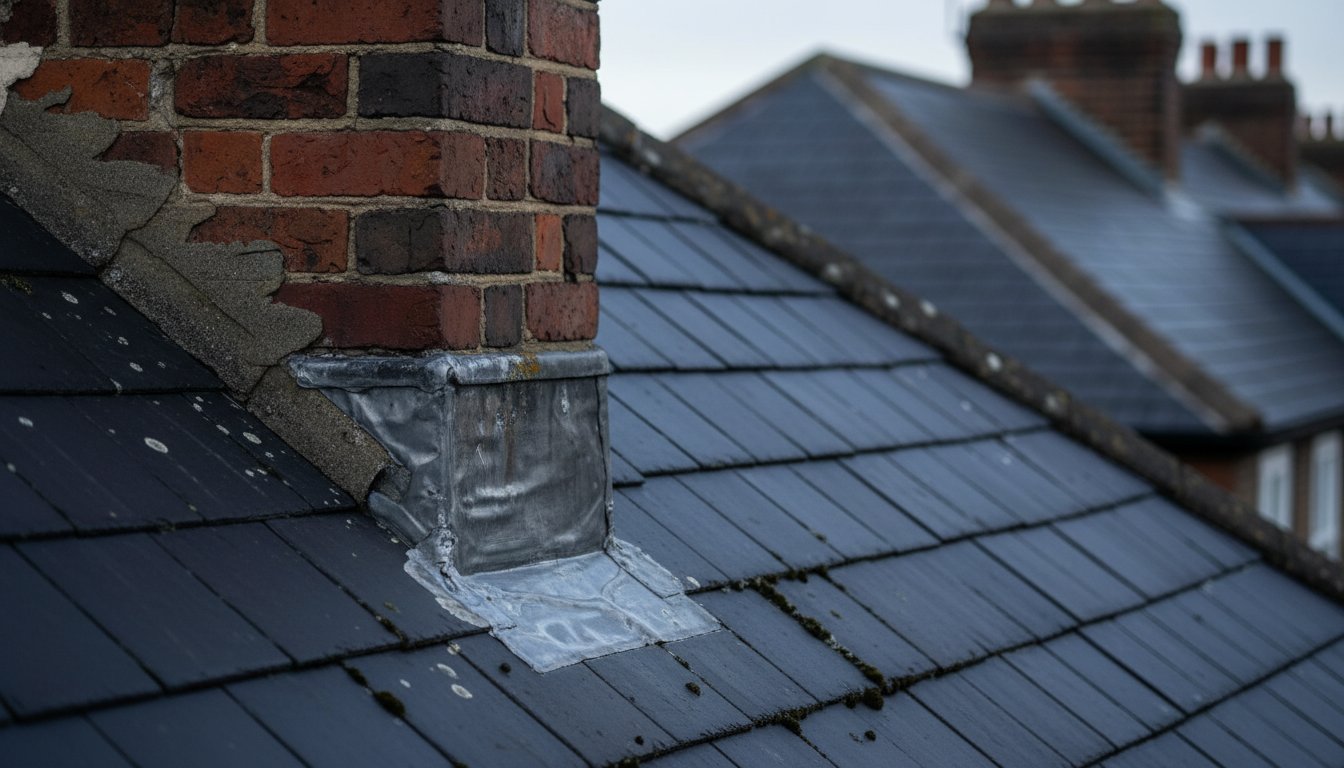
Chimneys are the most exposed part of any Norfolk roof. They take the full force of the wind and rain. In older properties, the mortar between the bricks often perishes due to the constant frost-thaw cycles we experience in East Anglia. When mortar cracks, water seeps behind the internal plasterwork, creating damp patches that look like a simple tile leak. We focus on two critical areas to keep your home dry:
- Lead Soakers and Flashings: These create a watertight seal between the chimney and the tiles. If they're cracked or lifted, rain will find its way in.
- Pointing: Fresh mortar prevents "blown" brickwork. This issue is responsible for roughly 40% of the chimney-related leaks we repair in NR1 and NR2.
In 1970s and 1980s estates in suburbs like Sprowston, we're seeing a different trend. The original bitumen underfelt used during construction is now reaching the end of its 40-year lifespan. It becomes brittle and tears. This means any minor tile slip leads to an immediate leak because there's no secondary barrier. Conversely, modern extensions often suffer from "false leaks." If a new kitchen extension isn't vented properly, warm air hits the cold roof deck and creates heavy condensation. This drips back onto the ceiling, mimicking a hole in the roof when the external structure is actually watertight. We always check your ventilation levels before recommending a repair to ensure we're fixing the right problem.
Detecting the Source: Why the Drip Isn’t Always Where the Leak Is
Finding a damp patch on your bedroom ceiling doesn't always mean the hole is directly above it. Water is a patient traveler. It follows the path of least resistance, which usually means it runs down your rafters or along the underlay before gravity finally pulls it onto your plasterboard. This trickery is one of the most frustrating roof leak causes Norwich homeowners face during our frequent Atlantic weather fronts. A leak at the ridge can easily manifest as a damp patch near the floor level if the water tracks down a vertical timber or an internal wall cavity.
Tracking Water Movement Along Rafters
Water can travel 4 or 5 metres horizontally before it finds a break in the insulation or a joint in the ceiling boards. We often look for "witness marks," which are the dried, brownish stains left behind on timber rafters. These marks act like a map, leading us back to the external breach. If your loft has thick mineral wool insulation, it can soak up litres of water like a heavy sponge. This often hides a leak for 3 to 6 months until the material is fully saturated and the weight causes the ceiling to sag. By the time you see a drip, the timber underneath has often been damp for weeks, increasing the risk of wood rot.
The "Invisible" Culprits: Flashing and Valleys
Hairline cracks in leadwork are difficult to spot from the ground. Over time, the expansion and contraction of metal can cause fatigue, allowing gallons of water to enter during a single storm. In Norwich, moss build-up is another major factor we see daily. Moss acts as a dam, holding moisture against the tiles and "wicking" it underneath the lap of the tile through capillary action. Keeping your roof clear is vital, and professional guttering services in Norwich are your first line of leak defence. If gutters are blocked, water backs up under the eaves, creating damp issues that look like roof leaks but are actually drainage failures.
During a heavy downpour, you can perform a safe visual check in your loft space to identify the entry point. Look for these specific signs:
- Sarking Felt Bulges: If the internal underlay is billowing or wet to the touch, the breach is likely higher up the roof slope.
- Daylight Gaps: If you can see pinpricks of light through the tiles, water is definitely getting past the primary layer.
- Rusty Nails: Look for orange or black streaks around clout nails in the rafters, which indicate long-term moisture exposure.
- Damp Insulation: Feel the top of the insulation near the eaves; if it's cold and heavy, the felt may have perished at the "drip edge."
Our family-run team has spent decades tracing these "ghost leaks" across Norfolk. We don't just patch the spot where it's dripping; we find the true source to ensure the repair lasts. If you're struggling to find the source of a drip, contact our team for a free, no-obligation estimate to secure your home.

Professional Leak Resolution: The I.R. Wilson Approach
At I.R. Wilson Roofing, we've spent over 20 years refining a service that puts the homeowner first. Our family-run team operates on a simple principle: we prioritse repair over replacement whenever it's structurally sound to do so. We know that a full roof replacement is a major investment, so we focus on pinpointing the specific roof leak causes Norwich properties face, from slipped slates to perished underlay, before suggesting a complete overhaul. This honest approach has built our reputation across Norfolk as a team that values your budget as much as your roof's integrity.
Technology has its place, but we don't rely on "drone-only" surveys. A camera from 30 feet up can't feel if a timber is soft or check the flexibility of old leadwork. We believe in a traditional, boots-on-the-roof inspection. By getting up on the tiles, we can identify the subtle signs of water ingress that a lens might miss. This hands-on method ensures our fixed-price quotations are accurate, preventing any nasty financial surprises halfway through the job. We also take great care to match local materials. Whether your home features traditional red Norfolk Pantiles or classic slate, we source matching products to ensure our repairs are seamless and preserve the historic aesthetic of our city.
Honest Advice from Local Experts
Choosing a roofing company in Norwich means finding someone who understands the local architecture. Our father-and-son team takes personal accountability for every project, distinguishing between urgent structural failures and simple maintenance tasks. We won't try to sell you a new roof if a targeted repair to the chimney flashing or guttering will solve the problem. This level of transparency is why our customers return to us year after year. We treat your home with the same care we'd treat our own, ensuring every fix is built to last.
Next Steps for Your Norwich Home
If you're worried about damp patches or missing tiles, the first step is a free, no-obligation estimate. During our site visit, we'll conduct a thorough diagnostic of your roof's condition and provide a clear, written quote. Every repair we undertake is fully insured and backed by our long-term guarantees, giving you total peace of mind. We've seen every one of the common roof leak causes Norwich weather can throw at a building, and we have the tools and experience to fix them properly the first time. Contact us today to secure your property against the elements and work with a team that values quality craftsmanship.
Secure Your Home Against Norwich Weather
Understanding the specific roof leak causes Norwich homeowners encounter is the first step toward a dry, secure property. Whether you are managing a Victorian terrace or a modern flat roof extension, identifying the true source of a drip requires a professional eye. Since 1994, our family-run team has seen how Norfolk’s specific weather patterns expose hidden vulnerabilities in tiles and leadwork. You don't have to guess where the water is coming from or rely on common maintenance myths that often lead to more damage.
We bring over 30 years of expert knowledge to every project, ensuring your repairs are handled with the quiet competence your home deserves. Our work is fully insured and all workmanship is guaranteed, providing the long-term reliability you expect from a local specialist. Taking action early prevents small leaks from becoming major structural issues. We are ready to help you protect your investment with honest advice and dependable service.
We look forward to helping you keep your home safe and dry for years to come.
Frequently Asked Questions
Is a roof leak always an emergency in Norwich?
A roof leak is a serious matter that requires immediate attention to prevent long-term structural damage. While a small drip might seem minor, water quickly rots roof timbers and can compromise your home's electrical wiring. In Norwich, our damp climate means moisture trapped in the attic leads to mould growth within 48 hours. We recommend addressing any sign of water entry before a simple repair turns into a costly structural project.
How much does it typically cost to fix a roof leak in Norfolk?
Typical roof repair costs in Norfolk range from £150 for small tile fixes to over £1,000 for more complex leadwork or valley repairs. These figures, based on 2024 industry averages from Checkatrade, vary depending on the height of your property and the materials required. We provide a free, no-obligation estimate for every job to ensure you have a fixed, transparent price before any work begins on your home.
Can I claim for roof leak repairs on my home insurance?
You can usually claim for roof repairs if the leak was caused by a sudden, identifiable event like a storm or a fallen tree. Most UK insurers, such as Aviva or Direct Line, won't cover leaks resulting from general wear and tear or a lack of maintenance. It's vital to check your specific policy wording. We can provide the professional damage reports and photographs your insurance company needs to process a claim.
How do I tell if my leak is coming from the roof or a plumbing issue?
You can identify the source by checking if the leak only occurs during or immediately after rainfall. If the damp patch appears regardless of the weather, it's likely a plumbing issue like a burst pipe or a leaking tank in the loft. One of the primary roof leak causes Norwich homeowners face is failed flashing around chimneys. If the water is clear and cold, it's often rainwater entering through a defect in your slating or tiling.
Why does my roof only leak when it is windy, but not during heavy rain?
Leaks that only occur during windy conditions are usually caused by rain being blown upwards under your tiles or through worn ridge pointing. This "wind-driven rain" bypasses the natural overlap of your roof covering. It's a common issue in exposed parts of Norfolk where high gusts force water into small gaps. We look for loose tiles or cracked mortar that stays watertight in vertical rain but fails when the wind shifts.
How long does a professional roof leak repair usually take?
Most minor roof repairs are completed within 2 to 5 hours on-site. If your project involves more extensive work, such as replacing a large section of leadwork or several rows of tiles, it might take a full working day. Our family-run team works efficiently to ensure your home is watertight as quickly as possible. We always aim to finish the job in one visit to minimize disruption to your daily routine.
Can moss on my roof cause a leak?
Moss is a significant factor among roof leak causes Norwich residents should watch for because it acts like a sponge. It holds moisture against the surface of your tiles, which leads to frost heave where the tile cracks during freezing winter temperatures. Thick moss also blocks your gutters and valleys, forcing water to back up under the tiles. Keeping your roof clear of debris is a simple way to extend the life of your slating.
Should I repair my flat roof or replace it entirely?
You should consider a full replacement if your flat roof is over 20 years old or if more than 25% of the surface shows signs of blistering or cracking. Modern EPDM or GRP systems offer much longer lifespans than traditional felt. If the leak is caused by a single puncture or a loose edge, a targeted repair is often a reliable and cost-effective solution. We'll assess the underlying decking to ensure it's structurally sound before recommending the best route.